Have You Seen BirdCast?

At first I started using eBird because I liked the idea of my everyday sightings being useful for science.  I quickly grew to love how simply it organized all my sightings and lists.  Eventually, I learned how to use the data myself, by looking at bar charts and maps.  More recently, I’ve been amazed by the animated occurrence maps made from eBird data.

Now the folks at eBird have teamed up with NOAA and others to create BirdCast.  Using predicted weather patterns along with records of past weather patterns and eBird data from past years, Cornell is now posting a weekly report of predicted migration patterns, as well as a followup summarizing what actually occurred.

Check out this week’s BirdCast report.  Reading over the section for the West, I learned to keep an eye out for the first Vaux’s Swifts this week.  Also, the Lawrence’s Goldfinches we have been seeing in recent weeks may begin to head west toward the core of their breeding range; hopefully, some of them will stick around to breed here!

Posted in eBird, Migration, News | Leave a comment

A Spectacle of Swallows

The field season has kicked off once again, and I spent the past ten days with the 2012 Great Basin Bird Observatory (GBBO) crew around Blythe and Yuma (Cibola and Imperial NWRs).  The beginning of the field season is the most difficult work, clearing trails and scouting plots to ensure that surveys go smoothly.

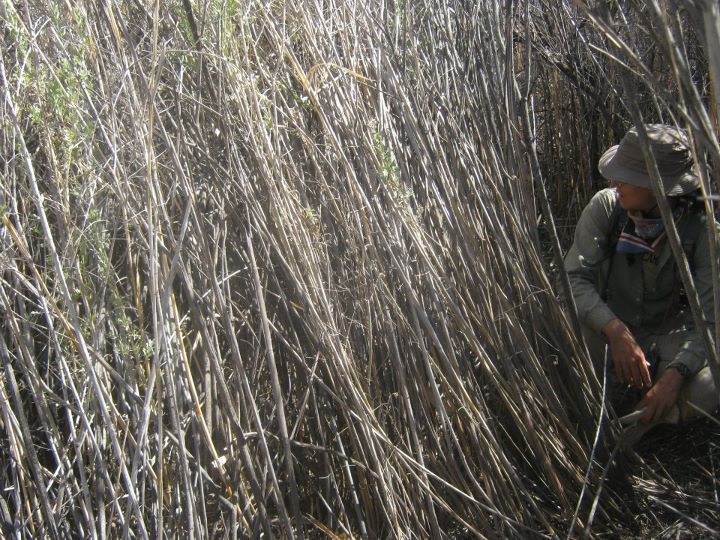
Resting on a small trail my crewmate and I carved through an arrowweed stand (Photo by Brandon Breen)

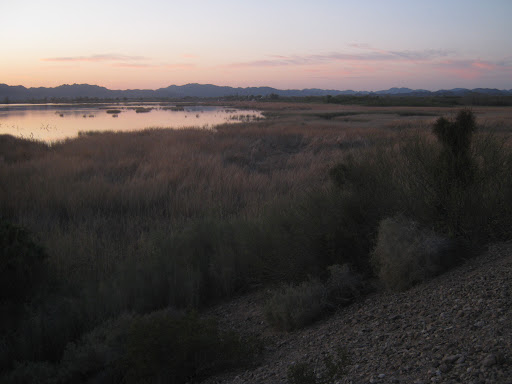
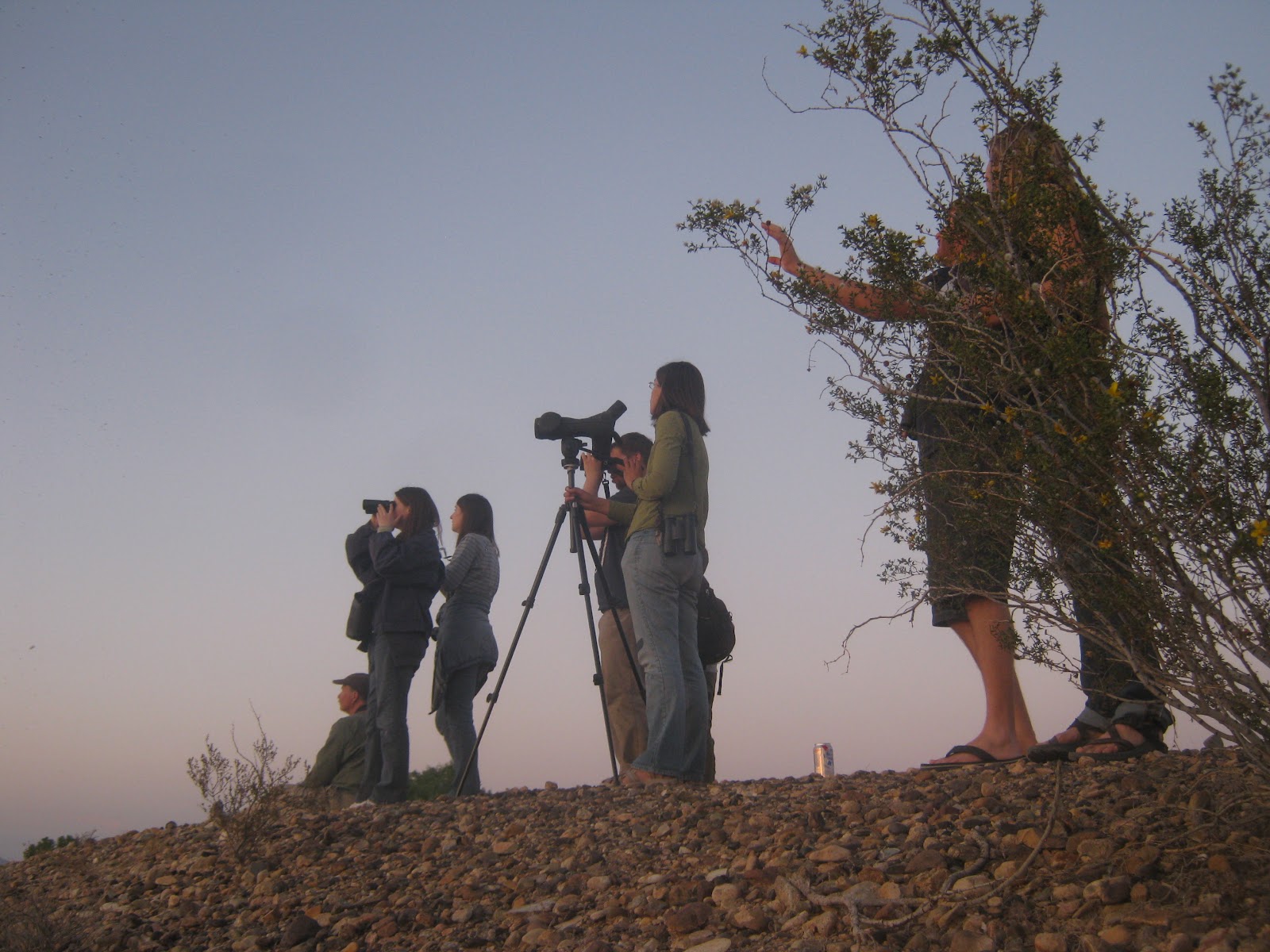
During this first tour, the crew spent several nights camping at Fishers Landing on Martinez Lake.  The campground itself was nothing to write home about, but the birding in the area was pretty good.  One thing we noticed at our campsite was that streams of hundreds of Tree Swallows would pass overhead each evening.  This was no surprise to any of us who had spent a spring along the Colorado River before, as migrating streams of swallows are a common sight out here.  One evening, though, we went up to an overlook point to scan the lake and we were impressed by the number of swallows streaming over the water, swirling over the marsh, and gathering in flocks high over the lake.  Eventually, all the swallows gained elevation and streamed into the masses high in the sky.  Numbers increased rapidly, from a few thousand to more than 20,000 as we stood and watched, estimating numbers repeatedly.  The ball of swallows moved through the sky with the liquidity of smoke, merging and splitting, climbing and shifting as the light dimmed.  Eventually, a few hundred birds broke off from the flock, diving almost straight down toward the marsh before breaking at the last moment and settling into the cattails, preparing to roost for the night.  As more and more birds joined in the plummet to the marsh, they appeared as whirling vortices to the naked eye, like twisting pillars of smoke.  Soon the clouds of swallows had drained to nothing, and as darkness fell, and two Black Rails began calling from the marsh, we headed back to the campsite.

The next night, having heard from us the spectacle we’d seen, most of the crew took the walk to the viewpoint.  The swallows were out again, streaming over the water and building in flocks over the marsh.  Eventually the flock built to an estimated 50,000 birds, more than twice the size of the previous evening’s flock, and twice as spectacular!

The swallows’ marsh
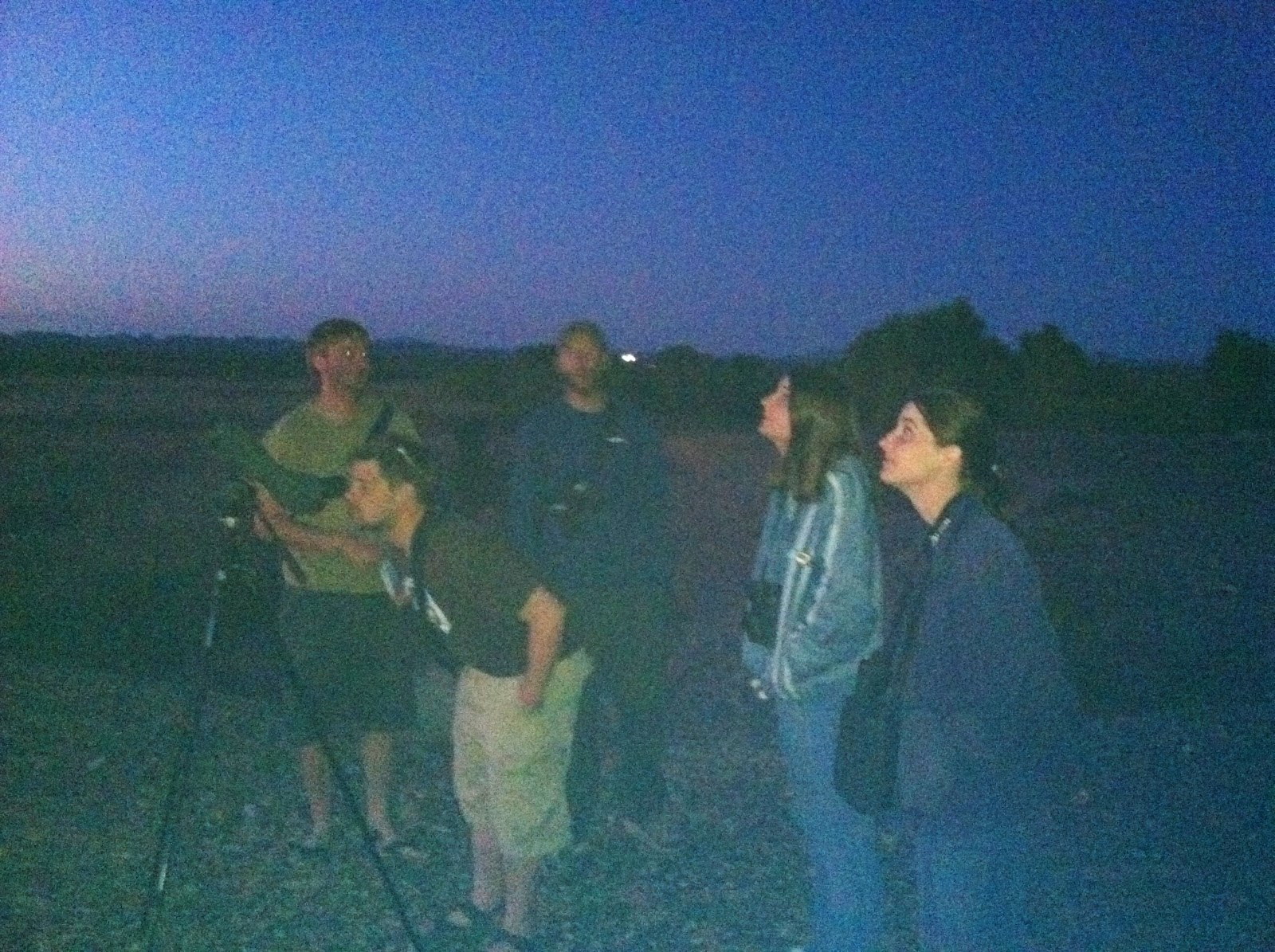
The crew enjoying the swallows (Both photos above by Brandon Breen)
Watching the swallows spiraling down to roost

I’ve seen some fantastic migration events, with the raptor migration of Veracruz topping the list: a constant stream of Broad-winged Hawks, Swainson’s Hawks, Turkey Vultures and others topping 250,000 in one day!  At Hazel Bazemore near Corpus Christi, TX, I’ve seen kettles over 10 and 20 thousand.  This sight of swallows gathering at dusk was equally spectacular to me as those kettles of hawks.  It occurred to me while I watched this that this surpassed any gathering of cranes in Arizona or New Mexico.  Why not have a March Swallow Festival?  After all, our count of 50,000 wasn’t even very high–last year’s high count was about one million, and that wasn’t unprecedented.  In early March last year, I counted nearly 3,200 Violet-green Swallows migrating over Rotary Park in an hour and a half.  This is a regular phenomenon in this area–even researchers are beginning to look at it using radar.  I would like to see a time in the near future when wildlife enthusiasts from all over the country (the world?) come to the Lower Colorado River Valley to see the swallow migration!

Posted in LCRV, Migration, Yuma County | 1 Comment

Nutting’s Flycatcher

By now, the Bill Williams Nutting’s Flycatcher is anything but news.  In the first week or two after its discovery, it was fun to see the bird mentioned in blog posts, Facebook feeds, and websites.  Now, more than five weeks later, I still enjoy being out there with people seeing it for the first time, and generally hearing from visitors.  One of my favorite stories that I’ve heard of the bird was from Joe Kahl, a biologist on the Lower Colorado River.  He was checking in to a hotel in Lake Havasu City, staying the night for some local bat research.  He only heard about the Nutting’s when a clerk at the hotel asked him, “Are you here for the rare bird?”  It’s a great thing for birders to be able to see a new species, but even better when locals learn that said bird brings in tourist dollars!  More recently, the Nutting’s has even been featured in the local newspaper.

The Discovery

The discovery of this bird took a lot of luck.  Since I was working on my Mohave County Big Year, David and I decided to do a day hike in the Bill Williams River riparian area on December 18.  We entered at what field biologists call the Cross-River Trail, which is the only point in the riparian where you enter Mohave County almost immediately (usually it takes at least a half-hour trek).  Soon after entering the forest, we found ourselves among a mixed flock of birds.  David started pishing, and then we heard this weird call.  We puzzled over it for a few minutes, eventually agreeing that it sounded like a Myiarchus flycatcher.  The only Myiarchus around, though, is Ash-throated Flycatcher, and this didn’t sound like one.  We puzzled some more, until David finally said what we were both thinking: “Maybe it’s a Nutting’s.”  I should add here that Nutting’s Flycatcher is always on our minds when we enter the Bill Williams riparian area, after one was recorded there in fall of 2008.

I got out my iPhone and flipped through every bird sound on it, but there was no Nutting’s Flycatcher.  We tried to find the bird, but it was invisible among the cottonwoods.  Eventually it moved away from the trail, and we were left to wonder.  We continued our hike, four hours of winding through the trail system on the river.  As we arrived back at the road further west of our entry point, the mystery call came up again.  Nutting’s Flycatcher seemed like the best possibility.  We went back to where we had heard the bird, and we did hear a single, distant call, but couldn’t get through the dense mesquite to where it had called from.

So it was back home for the day, and straight to xeno-canto.  It took some digging through all the songs of Nutting’s Flycatcher, but eventually I came across a recording of the single, long “wheep!”  I turned to David and said, “That was it.  It was a Nutting’s.”  Just to be sure, I went through the pages for other species, and Great Crested Flycatcher gave me pause.  A similar call, similar quality, but it seemed disyllabic, whereas the Bill Williams bird gave a call that was rising, but distinctly monosyllabic.  Clearly, though, we needed to be there the next day, better prepared for what was out there.

Armed with recordings, we arrived the next morning (December 19) to find a silent forest.  It took about an hour of wandering and listening before David’s sharp ears picked up a “wheep”.  We hurried toward the source of the call, playing “wheep”s back at it and confirming that they sounded identical.  We began to get frustrated, though, when the bird didn’t come in to the recordings.  It was only after David and I split up, and I crouched in a thick stand of black tamarisk trunks and played the song, that I heard a short, burry response, and the bird popped up in front of me.  It was a glorious thing!  Right there at eye level, with a tiny bill and lemon-yellow belly, it struck me how much it looked like a Dusky-capped Flycatcher.  After a moment, it flew over my head and flew toward the stream bank behind me.  The significance of this hit me quickly.  We understood that stream bank to be the county line, so it was possible that the bird had just flown from La Paz into Mohave County.  I hurried back to the stream bank and waited with David, and after a few seconds the bird popped up in the brush on the La Paz side, giving short, burry “wheep” calls in response to the tape.  I felt my heart skip a beat as the bird took wing, crossing over our heads and into a willow just on the Mohave side of the stream bank.  Now we had ample time to study the bird, to take photos and recordings, and to marvel at how this Mexican species could turn up on this river again.

We eventually dragged ourselves away from the bird to get the word out.  We ran into Refuge volunteers Bobby and Wayne Paintner on our way to the Headquarters, and told them of the bird.  We made excited phone calls from a rare point of cell reception at the Headquarters, then visited Refuge Ecologist Kathleen Blair to tell her all about it.  Over the next few days, we went out several times with friends to see the bird.  At first there were surprisingly few visitors.  Then calls and emails started coming in, and positive reports continued while David and I were in California from late December into early January.  Planet Ranch Road has now seen hundreds of visitors, and I still find birders there every time I visit.  The Nutting’s was even the last new species seen by John Vanderpoel in his recent Big Year.  A near-constant stream of friends has been coming to see the bird as well.  As much as I enjoy seeing and finding rare birds, it is a whole other dimension of birding to be able to share something exciting with fellow birders.

Posted in Bill Williams, La Paz County, LCRV, Mohave County, Vagrants | Leave a comment

Arizona’s Next Ten

While I’m occasionally adding to a blog post I’m writing about the Nutting’s Flycatcher, David Vander Pluym has been working on a very interesting project: a list of the birds he thinks will be added next to Arizona’s state list.  Only time will tell how accurate it is, but such projects always give birders something to think about and something to study up on for the next outing in the field.  Enjoy!

———

I’ve long been interested in vagrants and what might be the next birds to occur in an area. I’ve been meaning to put together a next 10 for Arizona and so a recent question by Jason Wilder and Brain Gatlin on the Northern Arizona Birds Forum got me thinking once again and I managed to come up with a “Next 10” list. I decided not to rank them and so the only order they are in is taxonomic.  I first started with a list of nearly 130 species of birds that seemed reasonably possible though some were very remote possibilities and there was a certain wishful thinking on some species. This larger list was easily whittled down to about 50 species but after that it got harder and I found it difficult to just pick 10 species. Nonetheless here is my pick of 10.

1. Surfbird – Uses the Gulf of California as a major stopover point in spring and is casual in spring in the Salton Sink. A spring migrant up the Colorado River (Yuma?) seems likely, but with records east to Texas and Florida (as well as the Black Turnstone record from Wilcox) a southeast Az record is not out of the question.
2. Curlew Sandpiper – with every surrounding state boasting records this seems long overdue for the state. Most interior records are for spring, when it is also easiest to identify, but pay attention in fall as well!
3. Ancient Murrelet – With records from the surrounding states and multiple records for the Salton Sink it seems a matter of time before one is recorded. Most likely in late fall but there are several late spring records for the Salton Sink (coming out of the Gulf of California?). Most suspect a record from Lake Havasu or elsewhere along the Colorado River, but this species is possible on any body of water or even in a parking lot!
4. Red-billed Pigeon – Occurs as close as 150 miles south of the border and like most pigeons is a strong flyer. Movements are not well known to me, but a vagrant seems plausible. It could be overlooked and hard to document, though, if one blasts by.
5. Alder Flycatcher – This one is almost certainly overlooked due to identification problems but with multiple records for the southeast deserts of California (including one from the Salton Sink) this species likely passes through Arizona. Either late spring or fall could produce this species at migrant traps across the state. Studying Willow Flycatchers and its whole range of variation in both plumage and vocalizations will help one prepare for the possibility of this species. Though vocalization recordings will be needed to confirm identification, some potential birds can be picked out by plumage. A willow flycatcher with a green back and crown, along with bold edgings to the flight feathers that strongly contrast with the rest of the wing, would be worth a closer look and perhaps enticed to call.
6. Fork-tailed Flycatcher – A species that could turn up anywhere, with records from both Nevada and California. Its penchant for wandering, as well as being easily identifiable, makes it a likely candidate to occur in the state.
7. Mangrove Swallow – Likely has some seasonal movements in the NW, as well as movements based on local conditions. This combined with its regular range extending nearly to the head of the Gulf of California makes it a prime candidate for occurrence. Should be looked for in large flocks of swallows moving north in spring as well as other seasons. Note that given its white rump, it may be passed off as a Violet-green Swallow.
8. White-throated Thrush – Similar range in west Mexico to Rufous-backed Robin (though not as far north) with known casual dispersal into Texas gives potential for wandering into Arizona as well. To be looked for anywhere robins occur.
9. Rusty Sparrow – A record seems overdue as it occurs very close to the border. Though it can be difficult to detect, learning the song and calls would be helpful in finding one.
10. Tricolored Blackbird – Though there are few records for the eastern deserts of California there are now multiple fall/winter records for the Salton Sink in the large blackbird flocks there. This may be the reward for anyone willing to pick through the large blackbird flocks in Yuma or elsewhere along the Colorado River.

Given the difficulties in predicting vagrant species the next new species to occur could easily be one not mentioned above as I left off many plausible species. White-tipped Dove, for example, was just recently mentioned on the AZ/NM listserve.  This species would have easily made a top 20 list of mine as it just barely didn’t make the cut (mainly as I thought a Red-billed Pigeon may be easier to document). One should study up on the identification of any of the possible species as who knows what may cross your path. Part of finding rare birds is knowing what to look for and how to pick one out from the common species (and how to document them), and of course getting out there regularly is also a major part of it.

See also articles on predicting vagrants in Birding May 2010 and Dec 2008 (as well as articles mentioned within).

What are your Next Ten?

David Vander Pluym

Posted in Vagrants | 3 Comments

2011 Big Year Summary!

I guess it was a strange thing to do, trying a Big Year as soon as I moved to a new county.  I was mainly inspired by Tommy D’s awesome Maricopa Big Year-ing, and I figured it would be a great way to get to know my new home county.  It turned out to be a lot of things: not only was it a lot of fun, and got me to explore the far corners of vast Mohave County, but it gave me incentive to get out there and bird as much as possible in 2011.  It turned out very well:  my goal was 300, but I managed to see 310 species in the county this year.  I should mention that David Vander Pluym, often my companion in the field, saw an impressive 307 species.
There were a lot of challenges to this endeavor.  To start with, I had only lived in Lake Havasu City a month before January 1 rolled around.  Of course, there aren’t a lot of local birders, and visits by out-of-area birders are infrequent.  I am very, very thankful for the birds I was able to chase, but it is a handicap that the area just isn’t well-covered.  Finally, there is the topography of the county itself.  Mohave is the 5thlargest county in the U.S., and there is a significant crack down the middle of it.  It was funny to head to Colorado City or Mount Trumbull, and reflect that I had to pass through California, Nevada, and Utah just to get there!  Of course, much of the county is desert, but there are a lot of gems with access to a variety of habitats in the county.  It was very convenient to have Kingman and the Hualapai Mountains only an hour’s drive from home, but places like Alamo Lake, Peach Springs and Wikieup really took a day’s commitment to bird.
Of the many locations I visited in 2011, my favorite spot is the viewpoint at the north end of Lake Havasu.  I got a whopping 68 year birds at this one location.  That high count is partially because I birded there January 1, but the rarities there were pretty amazing.  The best were Little Gull, Blackpoll Warbler, and Bobolink.  Cassin’s Sparrow was an astonishing rarity there as well, but I’ll talk about that later.  Next on the list of most year birds was the Hualapai Mountains, with 39 year birds!  This isn’t surprising, as I saw most of my pinyon/juniper/pine/mixed conifer species there.  Havasu NWR was a big help, with 20 year birds at Pintail Slough, 11 at Beal Lake, and 7 at Bermuda Pasture.  Of course I have to mention the always amazing Bill Williams River NWR—I saw 14 year birds in the Delta, and 22 along the river!
Considering first the birds I did see, the list of rarities is pretty amazing, and it’s interesting to compare the groups I did well in, and the groups I did not (note that all the Review Species below are pending review by the ABC).  Waterfowl were definitely in the former category.  I saw all but eight of the 40 waterfowl species ever seen in Arizona.  All four loons were seen; the Yellow-billedtook a lot of luck, as it was only seen once (to my knowledge) on the Mohave side of the Bill Williams Delta.  Tricolored Heron was a second? county record (first for San Bernardino), and Glossy Ibis was a first.  Raptors were an interesting category, as I had some good ones but I missed some that I should have gotten.  Harris’s Hawk was the best.  I couldn’t have asked for better luck with shorebirds, with 18 species on my list!  Highlights were Buff-breasted Sandpiper(sixth record for the state and first for the county) and Stilt Sandpiper (likely first for the county).  Gulls did not disappoint, either.  Little Gull was the second for the state and county, and Glaucous Gull was fourth for the state, first for the county.  Mew and Thayer’s Gulls were great additions as well.  A jaeger slam was very much hoped for, but unexpected!  My flycatcher list seems about average, except for the genus Myiarchus.  I was happy to hear the mournful calls of the county’s first Dusky-capped Flycatcher, but of course that pales in comparison to the Nutting’s Flycatcher!  Tropical Kingbird was another goodie.  Large thrushes were cooperative, including a Rufous-backed Robin (second for the county?) and a Varied Thrush.  I was hoping for one or two longspur species, so three was a great surprise—Lapland is a rarity but McCown’s may have been the county’s first.  I consider warblers to be one of the categories I didn’t do well in, but there were some good highlights.  I ended up with 18 species plus Olive Warbler.  This year saw the first documented Olive Warblers in the county.  A male Blackpoll Warbler was a very nice surprise, the county’s second.  Twenty species of sparrows isn’t bad, including Lark Bunting and Golden-crowned Sparrow.  Rufous-crowned Sparrow proved very difficult.  A lot of effort was put in looking for them, and all I got were a few call notes from a rocky slope!  The best sparrow was Cassin’s.  No previous county records, and David and I had at least seven in one morning near Peach Springs.  It was a great year for them across northern Arizona.  Still, I was not expecting to see one on the shore of Lake Havasu at the north end viewpoint!  As far as I know, this was only the second ever seen in the LCRV.
I didn’t list all the highlights above, but my full county year list is posted here.
Clearly, the birds I did get outweigh the birds I missed.  But any good Big Year comes with its painful misses, so I want to dedicate some space to them.  I consider White-throated Sparrow to be my biggest miss.  I had no idea that one could look through so many White-crowned Sparrows without finding a White-throated!  Bendire’s Thrasher was another that I put quite a bit of effort into with no results, which was particularly odd because I picked up the very difficult LeConte’s Thrasher.  I had hoped for either Yellow-bellied or Red-breasted Sapsucker, but at least I did get Williamson’s.  Eastern warblers are nearly absent from my list.  I eventually picked up Northern Parula and Black-and-white Warbler, but missed American Redstart and Northern Waterthrush (the latter wasn’t seen in Mohave this year at all).  Other birds seen in the county this year but not by me were Brant (I was working), Chukar (two trips to the Virgin Mtns didn’t pay off), Common Black-Hawk (I missed the birds at Beaver Dam, and never went to Mineral Wash), Black Rail, Sandhill Crane, Elf and Long-eared Owls (needed to have done the Bill Williams at night), Downy Woodpecker, Golden-crowned Kinglet (a frustrating miss), Black-capped Chickadee, and Painted Bunting (a great find by David Rankin at Esquerra Ranch).
As I mentioned above, one of the difficult aspects of a Mohave County Big Year is the fact that there are few birders out here.  For this reason, I am especially thankful for those who do bird out here, and the amazing birds that I was able to chase as well as their company out in the field.  So thanks to Jan Richmond (Long-tailed Duck), John West (Red-throated Loon and Red-shouldered Hawk), Paul Lehman and Barbara Carlson (Glossy Ibis), Sonia Kirkendall (Harris’s Hawk), Michael Nicosia and Rich Aracil (Black-bellied Plover), Chris McCreedy (Thayer’s Gull), John Saba and Chris Benesh et al. (Glaucous Gull), DeeDee DeLorenzo (Tropical Kingbird, American Crow), Dan Pittenger and Nathan Marcy (Olive Warbler), David Rankin (Bobolink) and of course David Vander Pluym.
There were some amazing moments this year.  Every new county bird was exciting, but some moments stand out.  I’ve already mentioned the Cassin’s Sparrows.  When a Bobolink flew overhead at the north end viewpoint, David Rankin and I thought it would be a bird that got away.  But when we pulled in at Rotary Park, several miles away, one of the first birds David spotted was the Bobolink foraging on the golf course!  I’ve only seen five birds in Mohave County that I didn’t see in 2011 (Western Gull, Black-legged Kittiwake, Downy Woodpecker, Clark’s Nutcracker, and Dickcissel), so many of the 2011 birds were county birds.  A good number were even state birds, and one (Nutting’s Flycatcher) was an ABA bird.  But only two were life birds.  The Little Gull was one, and it was incredible to see one foraging over the familiar north end of Lake Havasu.  The other was totally unexpected, spotted when I stopped to scan a small field on a whim: the Buff-breasted Sandpiper.  My goal for the year was 300, so when I saw a flock of Wild Turkeys in the road for #300, I was very pleased.  My last two birds of the year were two of the best moments of the year.  The Nutting’s Flycatcher was exciting far beyond the scope of a county big year, but imagine my glee when I checked a coordinate I got with my GPS against the official county map to see that I had indeed seen the bird ONE TREE on the Mohave side of the county line!  That was 309, and after adding that bird, I really had no desire to add something like White-throated Sparrow or Yellow-bellied Sapsucker as my last bird of the year.  I was content with 309, and considered my Big Year more or less over as of December 22.  I worked all day Dec 23, and was leaving for California before dawn on the 24th.  A wrench was thrown into that plan when the Glaucous Gull was refound while I was at work on the 23rd.  It was too dark to bird by the time I left that day, so plans were changed to try for it the morning of the 24th.  We didn’t have much time, though, since we had a long drive ahead, and the Glaucous is now notorious for being a very tough bird.  To my great relief and amazement, it took less than half an hour to find it on the 24th, and we even had time to watch it battle with a Herring Gull over a dead coot, and to show it to Tom Linda and Terry Blows.  I left for California on the 24th at 9 a.m., fully satisfied with my Big Year.
The past year was big for Arizona county big years.  Tommy DeBardeleben covered Maricopa, Shaun Putz birded Coconino, Doug Jenness did Pinal, and Mark Stevenson covered Pima.  The county big year is about discovery more than chasing.  It requires that birders visit areas seldom covered, and every one adds to our knowledge of birds in the state.  For anyone willing to put in some time, money, and miles on their car, a county big year is a very rewarding experience!
Posted in Big Year, Lake Havasu, LCRV, Mohave County, Trip reports, Vagrants | 4 Comments

Mohave County Big Year — Results!

Since I’m spending the holidays in California, my last day of 2011, at least as far as my big year is concerned, was December 24.  It was a great day to end the year, as we stuck around until morning to see the GLAUCOUS GULL!  With the Nutting’s Flycatcher coming before it, it’s pretty amazing that my last two birds of the year were both 4th state records.

The addition of Glaucous Gull left me with 310 for the year.  My goal, of course, was 300, and those extra 10 birds are not easy to get at that point!  I have two posts coming up, and I consider them mandatory!, one about the Nutting’s Flycatcher and another summarizing my big year.  Now is a busy time for me, though, with two Seasonal Reports to write that are due by the end of the month.  So for now, thanks to the wonders of eBird, I’ll just post my full year list.  It also includes the date and location where I first saw each species.

1 Greater White-fronted Goose Lake Havasu–North end viewpoint 29 Aug 2011
2 Snow Goose Lake Havasu City–N Pittsburgh Pt 03 Jan 2011
3 Ross’s Goose Havasu NWR–Pintail Slough/North Dike 29 Jan 2011
4 Cackling Goose Havasu NWR–Bermuda Pasture 11 Nov 2011
5 Canada Goose Lake Havasu City–Rotary Park 06 Jan 2011
6 Tundra Swan Lake Havasu–North end viewpoint 01 Jan 2011
7 Wood Duck Lake Havasu City – London Bridge 03 Jan 2011
8 Gadwall Crystal Beach 01 Jan 2011
9 Eurasian Wigeon Bill Williams River NWR (Mohave Co.) 01 Nov 2011
10 American Wigeon Crystal Beach 01 Jan 2011
11 Mallard Crystal Beach 01 Jan 2011
12 Blue-winged Teal LHC – Mulberry Ave STP 27 Jan 2011
13 Cinnamon Teal Havasu NWR–Pintail Slough/North Dike 24 Jan 2011
14 Northern Shoveler Lake Havasu–North end viewpoint 01 Jan 2011
15 Northern Pintail Crystal Beach 01 Jan 2011
16 Green-winged Teal Lake Havasu–North end viewpoint 01 Jan 2011
17 Canvasback Bill Williams River NWR (Mohave Co.) 02 Jan 2011
18 Redhead Lake Havasu–North end viewpoint 06 Jan 2011
19 Ring-necked Duck Lake Havasu–North end viewpoint 01 Jan 2011
20 Greater Scaup Bill Williams River NWR (Mohave Co.) 02 Jan 2011
21 Lesser Scaup Lake Havasu–North end viewpoint 01 Jan 2011
22 Surf Scoter Bill Williams River NWR (Mohave Co.) 02 Jan 2011
23 White-winged Scoter Lake Havasu 22 Jan 2011
24 Black Scoter Bill Williams River NWR (Mohave Co.) 02 Jan 2011
25 Long-tailed Duck Bill Williams River NWR (Mohave Co.) 01 Mar 2011
26 Bufflehead Lake Havasu–North end viewpoint 01 Jan 2011
27 Common Goldeneye Lake Havasu–North end viewpoint 01 Jan 2011
28 Barrow’s Goldeneye Bill Williams River NWR (Mohave Co.) 02 Jan 2011
29 Hooded Merganser Lake Havasu–North end viewpoint 06 Jan 2011
30 Common Merganser Lake Havasu–North end viewpoint 01 Jan 2011
31 Red-breasted Merganser Lake Mead NRA–Princess Cove 20 Feb 2011
32 Ruddy Duck Lake Havasu–North end viewpoint 01 Jan 2011
33 Gambel’s Quail 2841 McCulloch Blvd LHC 01 Jan 2011
34 Wild Turkey Mount Logan Rd – mid 20 Nov 2011
35 Red-throated Loon Lake Havasu City–Rotary Park 01 Nov 2011
36 Pacific Loon Lake Havasu–North end viewpoint 02 Sep 2011
37 Common Loon Lake Havasu–North end viewpoint 01 Jan 2011
38 Yellow-billed Loon Bill Williams Delta–outer, Mohave Co 21 Feb 2011
39 Pied-billed Grebe Lake Havasu–North end viewpoint 01 Jan 2011
40 Horned Grebe Lake Havasu SP — Site 4 06 Jan 2011
41 Red-necked Grebe Davis Dam (AZ) 11 Nov 2011
42 Eared Grebe Lake Havasu–North end viewpoint 01 Jan 2011
43 Western Grebe Bill Williams River NWR (Mohave Co.) 02 Jan 2011
44 Clark’s Grebe Bill Williams River NWR (Mohave Co.) 02 Jan 2011
45 Neotropic Cormorant Bill Williams River NWR (Mohave Co.) 12 Jan 2011
46 Double-crested Cormorant Bill Williams River NWR 02 Jan 2011
47 American White Pelican Havasu NWR–Beal Lake 21 Jan 2011
48 Brown Pelican Bill Williams Delta–Mohave Co 07 Nov 2011
49 Least Bittern Lake Havasu–North end viewpoint 18 May 2011
50 Great Blue Heron Lake Havasu–North end viewpoint 01 Jan 2011
51 Great Egret Crystal Beach 01 Jan 2011
52 Snowy Egret Havasu NWR–Catfish Paradise 05 Jan 2011
53 Tricolored Heron Lake Havasu–North end viewpoint 10 Aug 2011
54 Cattle Egret Lake Havasu City–Rotary Park 08 Apr 2011
55 Green Heron LHC – Mulberry Ave STP 27 Jan 2011
56 Black-crowned Night-Heron Bill Williams River NWR (Mohave Co.) 12 Jan 2011
57 Glossy Ibis Courtwright Rd 06 Jul 2011
58 White-faced Ibis Havasu NWR–Pintail Slough/North Dike 20 Feb 2011
59 Turkey Vulture Courtwright Rd 05 Jan 2011
60 Osprey Lake Havasu City–N Pittsburgh Pt 15 Jan 2011
61 Bald Eagle Alamo Lake–Upper 17 Jan 2011
62 Northern Harrier Lake Havasu–North end viewpoint 01 Jan 2011
63 Sharp-shinned Hawk Lake Havasu–Mesquite Bay North 16 Jan 2011
64 Cooper’s Hawk Lake Havasu–North end viewpoint 01 Jan 2011
65 Harris’s Hawk Yucca – Suzette and Mary Beth Dr 30 Jul 2011
66 Red-shouldered Hawk Havasu NWR–Pintail Slough/North Dike 24 Jan 2011
67 Swainson’s Hawk Havasu NWR–Bermuda Pasture 04 Apr 2011
68 Zone-tailed Hawk Big Sandy River @ Wikieup 28 May 2011
69 Red-tailed Hawk Bill Williams NWR – Kohen Ranch 02 Jan 2011
70 Ferruginous Hawk Kingman Airport Wilderness 11 Dec 2011
71 Rough-legged Hawk Flattop Reservoir 20 Nov 2011
72 Golden Eagle Hualapai Mountains – Wash in town 04 Feb 2011
73 American Kestrel Lake Havasu City–West/North Acoma 01 Jan 2011
74 Merlin Lake Havasu City–North 01 Jan 2011
75 Peregrine Falcon Lake Havasu–North end viewpoint 06 Jan 2011
76 Prairie Falcon Nautilus Elementary 13 Jan 2011
77 Clapper Rail Crystal Beach 01 Jan 2011
78 Virginia Rail Havasu NWR–Pintail Slough/North Dike 24 Mar 2011
79 Sora Havasu NWR–Beal Lake 21 Jan 2011
80 Common Gallinule Havasu NWR–Beal Lake 09 Apr 2011
81 American Coot Lake Havasu–North end viewpoint 01 Jan 2011
82 Black-bellied Plover Lake Havasu City WTP 14 Apr 2011
83 Snowy Plover Havasu NWR–Beal Lake 12 Aug 2011
84 Semipalmated Plover Havasu NWR–Pintail Slough/North Dike 12 Aug 2011
85 Killdeer Bill Williams River NWR 02 Jan 2011
86 Black-necked Stilt Lake Havasu City WTP 14 Apr 2011
87 American Avocet Lake Havasu–North end viewpoint 30 Mar 2011
88 Spotted Sandpiper Davis Dam (AZ) 29 Jan 2011
89 Solitary Sandpiper Lake Havasu City WTP 28 Apr 2011
90 Greater Yellowlegs Havasu NWR–Beal Lake 21 Jan 2011
91 Willet Lake Havasu City–Rotary Park 23 May 2011
92 Lesser Yellowlegs Lake Havasu City WTP 03 May 2011
93 Whimbrel Havasu NWR–Beal Lake 27 Aug 2011
94 Long-billed Curlew Lake Havasu–North end viewpoint 30 Mar 2011
95 Marbled Godwit Lake Havasu–North end viewpoint 31 Mar 2011
96 Sanderling Lake Havasu–North end viewpoint 29 Aug 2011
97 Semipalmated Sandpiper Havasu NWR–Beal Lake 25 Aug 2011
98 Western Sandpiper Lake Havasu City WTP 14 Apr 2011
99 Least Sandpiper Lake Havasu City WTP 11 Jan 2011
100 Baird’s Sandpiper Havasu NWR–Beal Lake 27 Aug 2011
101 Pectoral Sandpiper Havasu NWR–Beal Lake 25 Aug 2011
102 Dunlin Lake Havasu City WTP 28 Apr 2011
103 Stilt Sandpiper Havasu NWR–Beal Lake 25 Aug 2011
104 Buff-breasted Sandpiper Lake Havasu City WTP 03 Oct 2011
105 Short-billed Dowitcher Lake Havasu City WTP 24 Aug 2011
106 Long-billed Dowitcher Havasu NWR–Beal Lake 21 Jan 2011
107 Wilson’s Snipe Bill Williams River NWR 02 Jan 2011
108 Wilson’s Phalarope Lake Havasu City WTP 03 May 2011
109 Red-necked Phalarope Lake Havasu–North end viewpoint 09 May 2011
110 Red Phalarope Lake Havasu–North end viewpoint 11 Oct 2011
111 Sabine’s Gull Lake Havasu–North end viewpoint 07 Sep 2011
112 Bonaparte’s Gull Lake Havasu–North end viewpoint 30 Mar 2011
113 Little Gull Lake Havasu–North end viewpoint 10 Sep 2011
114 Franklin’s Gull Lake Havasu–North end viewpoint 26 Apr 2011
115 Mew Gull Bullhead City/Laughlin Bridge – restoration area 29 Jan 2011
116 Ring-billed Gull Lake Havasu–North end viewpoint 01 Jan 2011
117 California Gull Lake Havasu–North end viewpoint 01 Jan 2011
118 Herring Gull Lake Havasu City–N Pittsburgh Pt 11 Jan 2011
119 Thayer’s Gull Lake Havasu City WTP 21 Nov 2011
120 Glaucous Gull Lake Havasu–Site 6 24 Dec 2011
121 Caspian Tern Mohave Valley–Levee Rd cottonwoods 26 Mar 2011
122 Black Tern Lake Havasu–North end viewpoint 09 May 2011
123 Common Tern Lake Havasu–North end viewpoint 04 Jul 2011
124 Forster’s Tern Havasu NWR–Catfish Paradise 05 Jan 2011
125 Pomarine Jaeger Bill Williams Delta–Mohave Co 14 Nov 2011
126 Parasitic Jaeger Lake Havasu–North end viewpoint 06 Sep 2011
127 Long-tailed Jaeger Lake Havasu City–N Pittsburgh Pt 09 Sep 2011
128 Rock Pigeon 2841 McCulloch Blvd LHC 01 Jan 2011
129 Band-tailed Pigeon Hualapai Mountain Park 07 May 2011
130 Eurasian Collared-Dove Desert Hills 01 Jan 2011
131 White-winged Dove Lake Havasu City–Rotary Park 22 Feb 2011
132 Mourning Dove Desert Hills 01 Jan 2011
133 Inca Dove Mohave Valley–Willow Valley 06 Jul 2011
134 Ruddy Ground-Dove Lake Havasu City–Rotary Park 20 Oct 2011
135 Yellow-billed Cuckoo Havasu NWR–Pintail Slough/North Dike 09 Jul 2011
136 Greater Roadrunner Courtwright Rd 05 Jan 2011
137 Barn Owl Havasu NWR–Pintail Slough/North Dike 24 Jan 2011
138 Flammulated Owl Mount Trumbull 06 Aug 2011
139 Western Screech-Owl Mount Trumbull 06 Aug 2011
140 Great Horned Owl Lake Havasu City–Rotary Park 02 Jan 2011
141 Burrowing Owl Lake Havasu City–West/North Acoma 11 Jan 2011
142 Lesser Nighthawk Lake Havasu City–Rotary Park 15 Mar 2011
143 Common Nighthawk Mount Trumbull 06 Aug 2011
144 Common Poorwill Mount Trumbull 06 Aug 2011
145 Vaux’s Swift Lake Havasu–North end viewpoint 26 Apr 2011
146 White-throated Swift Bill Williams River NWR 02 Jan 2011
147 Black-chinned Hummingbird Mohave Valley–Levee Rd cottonwoods 26 Mar 2011
148 Anna’s Hummingbird Lake Havasu City–West/North Acoma 01 Jan 2011
149 Costa’s Hummingbird 2841 McCulloch Blvd LHC 07 Jan 2011
150 Broad-tailed Hummingbird Hualapai Mountain Park 21 Apr 2011
151 Rufous Hummingbird Hualapai Mountains – Atherton Rd 21 Apr 2011
152 Calliope Hummingbird Lake Havasu–North end viewpoint 07 Sep 2011
153 Belted Kingfisher Crystal Beach 01 Jan 2011
154 Lewis’s Woodpecker Lake Mead NRA–Katherine Landing 16 Oct 2011
155 Acorn Woodpecker Hualapai Mountain Park 05 Mar 2011
156 Gila Woodpecker Bill Williams River NWR 02 Jan 2011
157 Williamson’s Sapsucker Hualapai Mountain Park 11 Dec 2011
158 Red-naped Sapsucker Kingman–Metcalfe Park 19 Jan 2011
159 Ladder-backed Woodpecker Bill Williams River NWR 02 Jan 2011
160 Hairy Woodpecker Hualapai Mountain Park 05 Mar 2011
161 Northern Flicker Lake Havasu City–South 02 Jan 2011
162 Gilded Flicker Bill Williams NWR – Kohen Ranch 02 Jan 2011
163 Olive-sided Flycatcher Hualapai Mountain Park 05 Sep 2011
164 Greater Pewee Hualapai Mountain Park 30 Jul 2011
165 Western Wood-Pewee Lake Havasu–North end viewpoint 04 May 2011
166 Willow Flycatcher Lake Havasu–North end viewpoint 25 May 2011
167 Hammond’s Flycatcher Lake Havasu–North end viewpoint 29 Apr 2011
168 Gray Flycatcher Bill Williams NWR – Kohen Ranch 02 Jan 2011
169 Dusky Flycatcher Lake Havasu–North end viewpoint 14 Sep 2011
170 Pacific-slope Flycatcher Havasu NWR–Bermuda Pasture 26 Mar 2011
171 Cordilleran Flycatcher Hualapai Mountain Resort 02 Jul 2011
172 Black Phoebe Lake Havasu–North end viewpoint 01 Jan 2011
173 Eastern Phoebe Havasu NWR–Bermuda Pasture 16 Nov 2011
174 Say’s Phoebe Bill Williams River NWR 02 Jan 2011
175 Vermilion Flycatcher Lake Havasu SP — Site 4 06 Jan 2011
176 Dusky-capped Flycatcher Big Sandy River @ Wikieup 27 Feb 2011
177 Ash-throated Flycatcher Havasu NWR–Pintail Slough/North Dike 20 Feb 2011
178 Nutting’s Flycatcher Bill Williams NWR–Crossriver/North Burn/Fox Wash (MOH) 18 Dec 2011
179 Brown-crested Flycatcher Bill Williams River–Lincoln Ranch (MOH) 08 May 2011
180 Tropical Kingbird Havasu NWR–Pintail Slough/North Dike 09 Jul 2011
181 Cassin’s Kingbird Hualapai Mountains – Atherton Rd 21 Apr 2011
182 Western Kingbird Lake Havasu City–Rotary Park 14 Apr 2011
183 Loggerhead Shrike Crystal Beach 01 Jan 2011
184 Bell’s Vireo Bill Williams NWR – Kohen Ranch 11 Apr 2011
185 Gray Vireo Buck and Doe pt1 16 Jul 2011
186 Plumbeous Vireo Big Sandy River @ Wikieup 27 Feb 2011
187 Cassin’s Vireo Lake Havasu City–Rotary Park 09 Apr 2011
188 Hutton’s Vireo Hualapai Mountain Park 21 Apr 2011
189 Warbling Vireo Bill Williams River NWR (Mohave Co.) 11 Apr 2011
190 Pinyon Jay Mount Trumbull 07 Aug 2011
191 Steller’s Jay Hualapai Mountain Park 05 Mar 2011
192 Western Scrub-Jay Hualapai Mountain Rd – below town 04 Feb 2011
193 American Crow Havasu NWR–Pintail Slough/North Dike 11 Nov 2011
194 Common Raven 2841 McCulloch Blvd LHC 01 Jan 2011
195 Horned Lark Havasu NWR–Pintail Slough/North Dike 24 Jan 2011
196 Northern Rough-winged Swallow Havasu NWR–Pintail Slough/North Dike 24 Jan 2011
197 Purple Martin Lake Havasu–North end viewpoint 09 May 2011
198 Tree Swallow Lake Havasu–North end viewpoint 01 Jan 2011
199 Violet-green Swallow Lake Havasu City–N Pittsburgh Pt 01 Feb 2011
200 Bank Swallow Lake Havasu–North end viewpoint 26 Apr 2011
201 Barn Swallow Lake Havasu–North end viewpoint 06 Jan 2011
202 Cliff Swallow Lake Havasu–Boston Lighthouse Trail 24 Feb 2011
203 Mountain Chickadee Hualapai Mountain Park 05 Mar 2011
204 Juniper Titmouse Hualapai Mountains – Wash in town 04 Feb 2011
205 Verdin Lake Havasu–North end viewpoint 01 Jan 2011
206 Bushtit Hualapai Mountains – Wash in town 04 Feb 2011
207 Red-breasted Nuthatch Hualapai Mountain Park 21 Apr 2011
208 White-breasted Nuthatch Hualapai Mountain Park 04 Feb 2011
209 Pygmy Nuthatch Hualapai Mountain Park 04 Feb 2011
210 Brown Creeper Hualapai Mountain Park 05 Mar 2011
211 Cactus Wren Bill Williams NWR – Kohen Ranch 02 Jan 2011
212 Rock Wren Alamo Lake SP (Mohave Co.) 17 Jan 2011
213 Canyon Wren Alamo Lake SP (Mohave Co.) 17 Jan 2011
214 Bewick’s Wren Havasu NWR–Pintail Slough/North Dike 29 Jan 2011
215 House Wren Havasu NWR–Pintail Slough/North Dike 24 Jan 2011
216 Marsh Wren Lake Havasu–North end viewpoint 01 Jan 2011
217 Blue-gray Gnatcatcher Lake Havasu–North end viewpoint 01 Jan 2011
218 Black-tailed Gnatcatcher Lake Havasu–North end viewpoint 01 Jan 2011
219 Ruby-crowned Kinglet Lake Havasu–North end viewpoint 01 Jan 2011
220 Western Bluebird Hualapai Mountain Rd – below town 04 Feb 2011
221 Mountain Bluebird Upper Hurricane Valley 06 Aug 2011
222 Townsend’s Solitaire Lake Havasu City–Rotary Park 18 Oct 2011
223 Swainson’s Thrush Hualapai Mountain Park 07 May 2011
224 Hermit Thrush Bill Williams NWR – Kohen Ranch 02 Jan 2011
225 Rufous-backed Robin Kingman–Metcalfe Park 19 Jan 2011
226 American Robin Kingman–Metcalfe Park 19 Jan 2011
227 Varied Thrush Colorado City – Cotton wood Park 20 Nov 2011
228 Gray Catbird Havasu NWR–Catfish Paradise 05 Oct 2011
229 Northern Mockingbird Lake Havasu City–West/North Acoma 01 Jan 2011
230 Sage Thrasher Sacramento Valley–Cottonwood Rd 30 Jan 2011
231 Curve-billed Thrasher Kingman–Metcalfe Park 19 Jan 2011
232 Crissal Thrasher Lake Havasu–North end viewpoint 01 Jan 2011
233 Le Conte’s Thrasher Lake Mead NRA–Bonelli Landing Rd 30 Jan 2011
234 European Starling Lake Havasu City–West/North Acoma 01 Jan 2011
235 American Pipit Bill Williams River NWR 02 Jan 2011
236 Cedar Waxwing Lake Havasu–North end viewpoint 20 Apr 2011
237 Phainopepla Bill Williams NWR – Kohen Ranch 02 Jan 2011
238 Olive Warbler Hualapai Mountain Park 30 Jul 2011
239 Lapland Longspur Courtwright Rd 27 Nov 2011
240 Chestnut-collared Longspur Lake Havasu–North end viewpoint 08 Oct 2011
241 McCown’s Longspur Courtwright Rd 27 Nov 2011
242 Black-and-white Warbler Lake Havasu City–Rotary Park 15 Nov 2011
243 Orange-crowned Warbler Lake Havasu–North end viewpoint 01 Jan 2011
244 Lucy’s Warbler Havasu NWR–Bermuda Pasture 26 Mar 2011
245 Nashville Warbler Lake Havasu City–Rotary Park 26 Apr 2011
246 Virginia’s Warbler Hualapai Mountain Park 21 Apr 2011
247 MacGillivray’s Warbler Hualapai Mountain Rd–Rd 7101C 07 May 2011
248 Common Yellowthroat Lake Havasu–North end viewpoint 01 Jan 2011
249 Northern Parula Havasu NWR–New South Dike 16 Oct 2011
250 Yellow Warbler Lake Havasu–North end viewpoint 20 Apr 2011
251 Blackpoll Warbler Lake Havasu–North end viewpoint 18 May 2011
252 Yellow-rumped Warbler Lake Havasu–North end viewpoint 01 Jan 2011
253 Grace’s Warbler Hualapai Mountain Park 21 Apr 2011
254 Black-throated Gray Warbler Hualapai Mountain Park 21 Apr 2011
255 Townsend’s Warbler Lake Havasu–North end viewpoint 29 Apr 2011
256 Hermit Warbler Mount Trumbull 07 Aug 2011
257 Wilson’s Warbler Havasu NWR–Bermuda Pasture 26 Mar 2011
258 Red-faced Warbler Hualapai Mountain Park 07 May 2011
259 Painted Redstart Hualapai Mountain Park 07 May 2011
260 Yellow-breasted Chat Lake Havasu–North end viewpoint 20 Apr 2011
261 Green-tailed Towhee Lake Havasu City–Rotary Park 26 Apr 2011
262 Spotted Towhee Hualapai Mountain Rd – below town 04 Feb 2011
263 Rufous-crowned Sparrow Near Valentine MOH 16 Jul 2011
264 Canyon Towhee Oatman Highway – MP 27 29 Jan 2011
265 Abert’s Towhee Lake Havasu–North end viewpoint 01 Jan 2011
266 Cassin’s Sparrow Buck and Doe Rd and Rt 66 16 Jul 2011
267 Chipping Sparrow Nautilus Elementary 08 Apr 2011
268 Clay-colored Sparrow Lake Havasu–North end viewpoint 09 Sep 2011
269 Brewer’s Sparrow Big Sandy River @ Signal Rd 27 Feb 2011
270 Black-chinned Sparrow Hualapai Mountains – Atherton Rd 21 Apr 2011
271 Vesper Sparrow Havasu NWR–Pintail Slough/North Dike 24 Jan 2011
272 Lark Sparrow Buck and Doe Rd and Rt 66 16 Jul 2011
273 Black-throated Sparrow Oatman Highway – MP 27 29 Jan 2011
274 Sage Sparrow Bill Williams NWR – Kohen Ranch 02 Jan 2011
275 Lark Bunting Kingman Airport Wilderness 11 Dec 2011
276 Savannah Sparrow Lake Havasu City WTP 11 Jan 2011
277 Song Sparrow Bill Williams NWR – Kohen Ranch 02 Jan 2011
278 Lincoln’s Sparrow Havasu NWR–Pintail Slough/North Dike 24 Jan 2011
279 White-crowned Sparrow Bill Williams NWR – Kohen Ranch 02 Jan 2011
280 Golden-crowned Sparrow Burro Creek CG 27 Feb 2011
281 Dark-eyed Junco Hualapai Mountains – Wash in town 04 Feb 2011
282 Hepatic Tanager Wild Cow Springs Campground 02 Jul 2011
283 Summer Tanager Havasu NWR–New South Dike 15 May 2011
284 Western Tanager Lake Havasu–North end viewpoint 29 Apr 2011
285 Northern Cardinal Big Sandy River @ Wikieup 28 May 2011
286 Black-headed Grosbeak Hualapai Mountains – Atherton Rd 21 Apr 2011
287 Blue Grosbeak Havasu NWR – Beal Lake Restoration area 19 May 2011
288 Lazuli Bunting Lake Havasu–North end viewpoint 26 Apr 2011
289 Indigo Bunting Havasu NWR–Pintail Slough/North Dike 09 Jul 2011
290 Bobolink Lake Havasu–North end viewpoint 21 Sep 2011
291 Red-winged Blackbird Crystal Beach 01 Jan 2011
292 Eastern Meadowlark Buck and Doe Rd and Rt 66 16 Jul 2011
293 Western Meadowlark Havasu NWR–Pintail Slough/North Dike 05 Jan 2011
294 Yellow-headed Blackbird Nautilus Elementary 22 Mar 2011
295 Brewer’s Blackbird The Shops at Lake Havasu 01 Jan 2011
296 Great-tailed Grackle The Shops at Lake Havasu 01 Jan 2011
297 Bronzed Cowbird Lake Havasu City–Rotary Park 17 May 2011
298 Brown-headed Cowbird Lake Havasu City–Rotary Park 15 Mar 2011
299 Hooded Oriole Bill Williams River NWR (Mohave Co.) 11 Apr 2011
300 Bullock’s Oriole Havasu NWR–Bermuda Pasture 04 Apr 2011
301 Scott’s Oriole Hualapai Mountains – Atherton Rd 21 Apr 2011
302 Cassin’s Finch Hualapai Mountain Park 21 Apr 2011
303 House Finch Desert Hills 01 Jan 2011
304 Red Crossbill Hualapai Mountain Park 05 Mar 2011
305 Pine Siskin Hualapai Mountain Park 05 Mar 2011
306 Lesser Goldfinch Lake Havasu City–Rotary Park 02 Jan 2011
307 Lawrence’s Goldfinch Bill Williams River NWR (Mohave Co.) 11 Apr 2011
308 American Goldfinch Havasu NWR–Pintail Slough/North Dike 26 Mar 2011
309 Evening Grosbeak Hualapai Mountain Resort 21 Apr 2011
310 House Sparrow Lake Havasu City – London Bridge 03 Jan 2011
Posted in Big Year, Mohave County | Leave a comment

Christmas Bird Count!

It’s that time of year again!  The count period for Audubon’s Christmas Bird Count begins tomorrow, December 14.  Have you figured out which CBCs you’ll be participating in this year?  Will you be counting in one or two local circles or will you be traveling to experience a new area?

If you haven’t decided yet, now’s the time to figure it out and contact compilers!  You can see a map and list of Arizona counts here, California counts here, and Nevada counts here.

The LCRV is home to several great counts.  My local counts are on the Bill Williams River and Havasu NWRs, December 28 and 29.  Both provide a great opportunity to explore these fabulous refuges!  Further south is the Yuma count on Dec 31, and further north there is a CBC in Henderson, NV Dec 14.  Nearby but not in the LCRV is one of my favorite counts, the Salton Sea South, which is next Tuesday, Dec 20.  It is the perfect opportunity to experience the amazing Salton Sea, and there are always rarities to chase in the afternoon!

So what counts will you be participating in this year?  Myself, it’s looking like I’m going to miss the CBC entirely, as my upcoming trip to California will not have us near any count circle on its count day!  Oh well, there’s always next year…

Posted in Christmas Bird Counts, Events | Leave a comment

Searching for ‘Spurs

I admit it, my blogging has suffered lately as it falls further down on my list of priorities.  I have made a personal resolution to post more, and I have a draft post half-written about my recent revisit to the Arizona Strip!  In the meantime, since I had a very nice morning of birding, I thought I’d jot a few lines about the experience of looking for longspurs (Spoiler: it’s more than a few lines).

The most expected species of longspur in the LCRV (and across Arizona) is Chestnut-collared.  I picked up 2 or 3 migrant Chestnut-collars earlier this fall, all heard giving their distinctive “kiddle-diddle” call.  I knew the other three species would be much more difficult to pick up.  Lapland is rare anywhere in Arizona, but they probably occur annually in the LCRV.  McCown’s, on the other hand, winters in southeast Arizona and turns up semi-regularly in central Arizona, but it is casual in the LCRV.  Smith’s has not been recorded in the LCRV at all, although it has turned up at the Salton Sea.

Two days ago, while birding with Paul Lehman and Barbara Carlson, we made a stop at some fields in the Mohave Valley that were recently plowed and covered in Horned Larks.  This is the perfect situation for Lapland Longspur–and not bad for McCown’s, either.  Both species prefer bare ground (Chestnut-collared and Smith’s prefer grass).  So today, dreaming of ‘spurs, David and I returned to those fields ready to spend a day staring at dirt and gray birds.  We arrived at the fields around 10:00 and soon saw swarms of larks.  Driving down a few farm roads, we positioned ourselves in decent light fairly close to some lark flocks, and we began to scan.

My strategy for longspur searching goes something like this:
1. Find a field with a bunch of horned larks
2. Listen when the larks fly for longspur flight calls
3. Scan through foraging larks, looking for, well, anything that’s not a lark
4. Look through flying lark flocks for longspurs flashing their distinctive tail patterns

It turns out that all those points have their challenges.  The Mohave Valley hasn’t had large lark flocks until recently, when a number of the fields were plowed or harvested.  Listening for longspurs in a flock of larks can be the best way to find them, but of course you’re trying to ignore the many little lark calls and hoping to pick out a rattle (which all four species do), the “kiddle-diddle” of Chestnut-collared, or the “pink” of a McCown’s.  It takes some practice to pick out ‘spurs visually, whether the birds are flying or feeding.  They tend to hunch down while they feed and hide behind clumps of grass or dirt.  In flight, the flocks twist and turn, but there’s the chance to catch a glimpse of a distinctive tail pattern (all four species are different).

I was focusing on point #3, scoping through a lark flock looking for streaky skulkers, when a few birds flew in to join the flock.  As one of these birds banked, I saw a black-and-white tail with more white toward the body and a dark tip.  It wasn’t a good enough view to tell if it was a McCown’s or Chestnut-collared, but it was a longspur tail.  The bird soon came out from behind a clod of dirt and I noted a broad buffy supercilium with a hint of darker auriculars, a fairly plain face pattern.  Then it turned and I saw rufous lesser coverts: a McCown’s Longspur!  David was able to see it and we studied the bird for a few minutes before the flock took flight and reshuffled.

David then walked down the road to scan another field full of larks, while I stayed to scan the same flock.  After a few minutes, another ‘spur walked across my field of view.  This one was streaky, much streakier than the McCown’s.  As it walked I noted a dark border to the auriculars and rufous greater coverts, and I called to David that I had a Lapland Longspur!  He ran up but the flock reshuffled before he was able to see the bird.  We continued scanning, hoping to spot it again, and soon David said that he had a Lap.  Looking in David’s scope, I saw a different bird than the one I had seen–a much brighter individual with a black breast patch.

Within 20 minutes we had seen three longspurs, a Lapland and a McCown’s!  We ended up staying for another hour, until the wind picked up and I couldn’t see objects as single images anymore.  As lark flocks flew overhead, we heard short rattles of longspurs, and David saw a Chestnut-collared to add to the day’s list.  Not a bad way to spend the morning!

Posted in LCRV, Mohave County, Techniques, Vagrants | 2 Comments

The Arizona Strip, v.2

With the mid-November chill in the air, it was time for a second visit to the Arizona Strip!  Why go again in mid-November?  Well, mostly to look for Black-capped Chickadees in Colorado City.  I was also hoping for wandering non-breeders to show up on Mt. Trumbull, such as Williamson’s Sapsucker, Downy Woodpecker, and Golden-crowned Kinglet.  Then there’s the influx of Ferruginous Hawks that happens in winter in northern Arizona, with birds from further north replacing the scarce breeding population that I missed this summer.  Of course, rarities are always a possibility, and November is a great time to find rarities in Arizona!

As it turned out, I saw little that I had hoped for, but did see a few less-expected species.  Birding will surprise you every time!

Our plans went through several forms.  We had planned on going November 11-13, but the weather called for rain, which does a nasty number on the Strip’s dirt roads.  The 19th and 20th provided less time and windier weather, but staying dry (and out of the ditches) was a big bonus.  Barbara Carlson, a friend from San Diego, decided she wanted to join us at the beginning of our journey to look for Chukar.  A wrench came into those plans when a Harris’s Sparrow turned up at Catfish Paradise, about 30 minutes north of Lake Havasu City!  Since it would be a state bird for all three of us (Barbara, David and I), we decided to start at dawn at Catfish instead of leaving earlier.  The Chukar, we figured, would still be wandering by late morning.

Catfish was perhaps birdier than I’ve ever seen it, with flocks of Red-shafted Flickers, plus one rare Gilded Flicker!  The Harris’s Sparrow never materialized, unfortunately, and we left after about an hour of poking through every tamarisk and patch of arrowweed in the place.

The drive to the Strip from Lake Havasu is a long one, taking about four hours to get back into Arizona after driving through California and Nevada to get around the Grand Canyon and Lake Mead.  We arrived in Lime Kiln Canyon in the Virgin Mountains hoping for Chukar, a partridge introduced to the western United States.  They had been seen recently in the area, but despite much climbing around and scanning distant hillsides, none materialized for us.

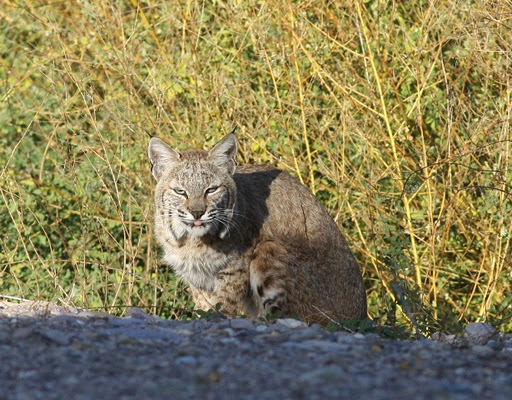
With two dips already for the day, we parted ways with Barbara, feeling a little down.  David and I continued on to Beaver Dam, where Barbara and Paul Lehman had recently found a White-throated Sparrow on the golf course.  It’s always a bit nerve-wracking walking into a golf course pro shop to ask permission to bird the course!  To our amazement, though, the slightly confused-looking lady behind the desk told us it should be fine, and would we please sign this release to rent a golf cart!  Declining her generous offer, we wandered around the course on foot.  A few birds were about but the hoped-for Zonotrichia flocks were meager, and no rarities were seen.  Strike three!  Our one highlight was a Bobcat sunning itself in the afternoon sun, more or less oblivious to any danger from us.

Next, with a short detour through Utah, we pointed the car south toward Mount Trumbull.  In the faint evening light I scanned fenceposts for Short-eared Owls, but the drive proved uneventful.  Arriving at my favorite campsite on Mt. Trumbull, the car’s temperature gauge read 37–pretty chilly for a couple of desert dwellers!  Nonetheless, we bundled up and took a walk under starry skies, listening for owls.

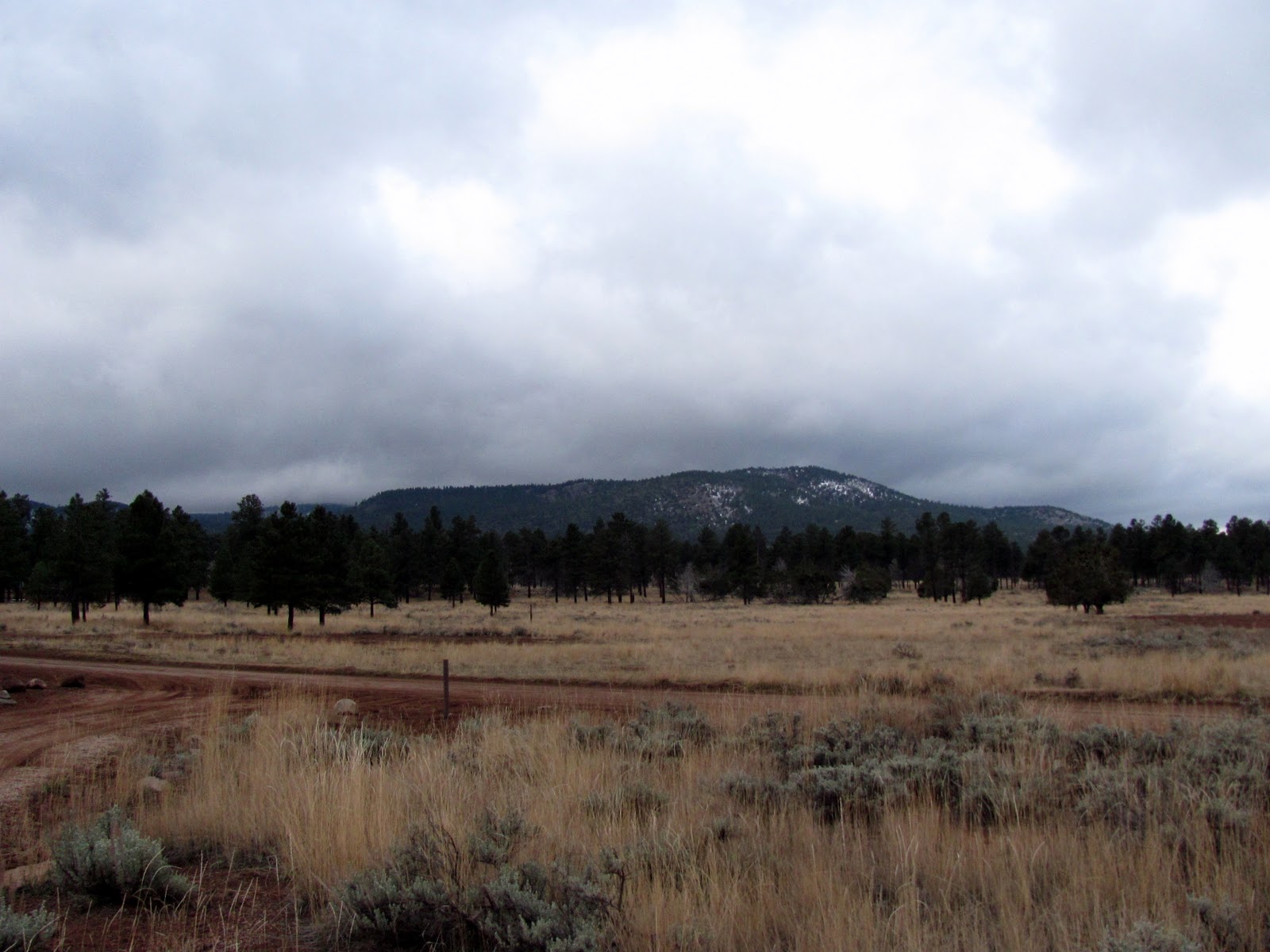
Dawn, looking toward Mt. Logan

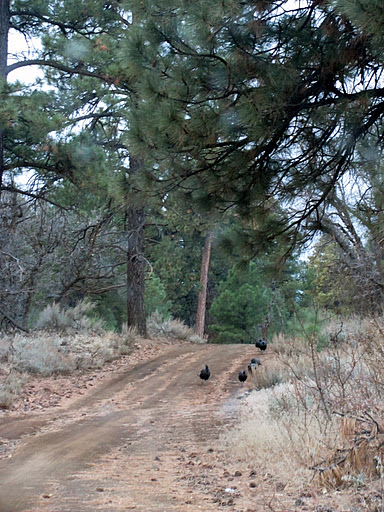
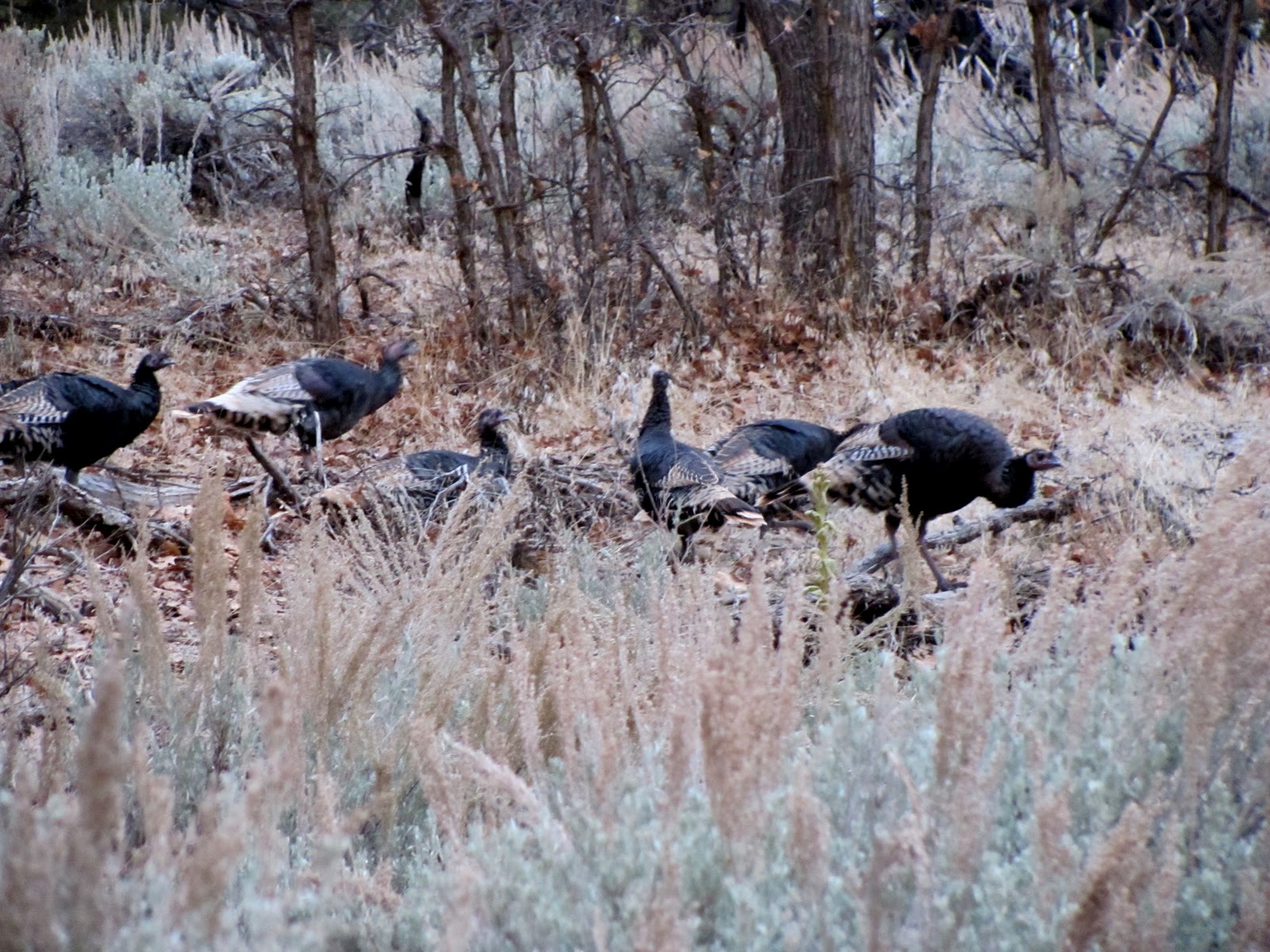
The next morning, the temperature gauge didn’t budge from 37, and the skies were overcast.  Since we didn’t have enough time to hike Mt. Trumbull (and it didn’t seem worth the effort in any case), we tried the drive up Mount Logan, stopping periodically at likely birding spots.  It was on this road that I got the magic 300, my goal for my Mohave County Big Year, in the form of a flock of 13 Wild Turkeys in the road!

Not exactly a rarity for #300, but it is very local and hard to get in the county, besides being fitting for Thanksgiving-time.

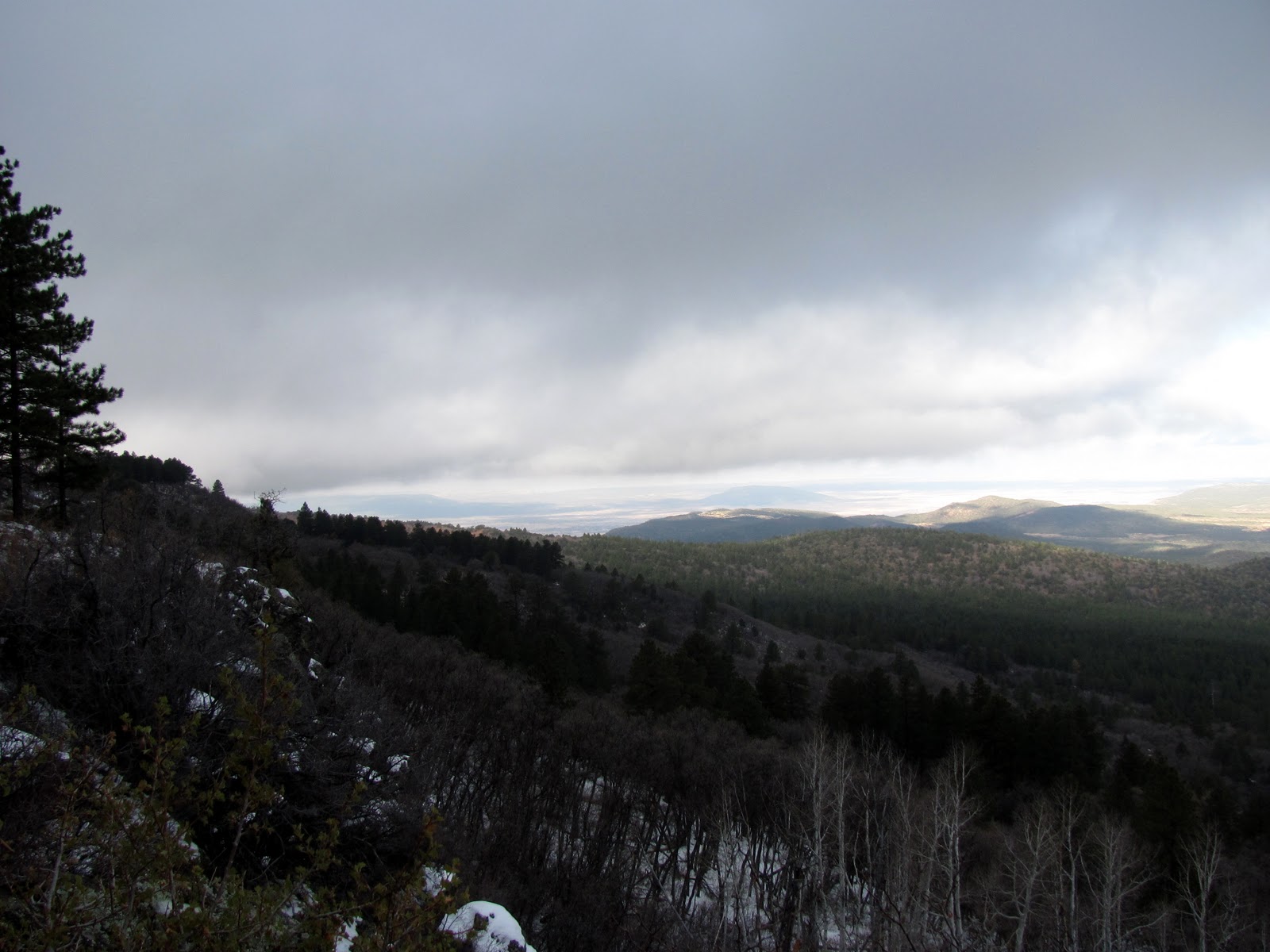
Overall there were plenty of birds to see, the most interesting to me (besides the turkeys) being Cassin’s Finches and lots of juncos: Oregon, Gray-headed, a few Pink-sided, and a handful of birds that looked like Red-backed but with paler bills.  We eventually reached the top of the road at Mt. Logan, where a lovely viewpoint overlooks the Strip to the northwest and Mount Trumbull.
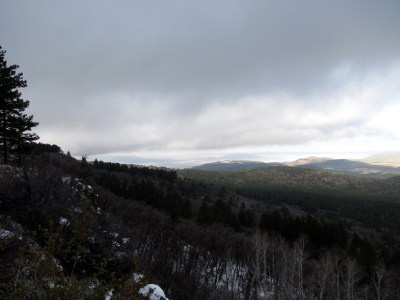
The view to the west from Mt. Logan

Before long we decided it was time to go, if we wanted to bird Colorado City before heading home.  We stopped at a few tanks along the way but found the birding slow overall.  The welcome highlight was a Rough-legged Hawk flying over a tank about 10 miles south of Colorado City!

Rough-legged Hawk.  Photo by David Vander Pluym.

Colorado City itself is a strange place.  Its existence and the habits of its population are interesting topics, but perhaps for another blog!  The small town is situated among red rocks, with the green ribbon of Short Creek running through it.  Located directly on the Utah border, the riparian habitat there can turn up some good birds, especially Black-capped Chickadee, our target bird.  After covering the area for a few hours, we weren’t able to turn up any chickadees, but we did find a rare Yellow-shafted Flicker and a county bird, Varied Thrush!

Varied Thrush.  Photo by David Vander Pluym.

Although this trip didn’t produce the species we had hoped for, I did manage to get several county year birds, and enjoyed some good birding, nice scenery and great company!

Posted in Arizona Strip, Big Year, Mohave County, Trip reports | 1 Comment

Check out AZFO’s annual meeting

October has come around, and it has brought a lot of excitement with it.  The rare birds are a plus, but the weather has been the star of the show.  Highs have been in the 70s and 80s, we’ve had some cloudy days, and being outside has been enjoyable!

But birds and weather aren’t the only excitement that October brings.  We’re also looking forward to AZFO’s Annual Meeting in north Phoenix October 21-23!

There is a lot to look forward to this year.  I’m particularly excited about Friday’s birding blitz on the Hassayampa River, and all three of Sunday’s mini-expeditions should be excellent.  All three visit underbirded locations near the meeting site (which is the Game and Fish Office on Carefree Hwy.) – Morgan City Wash, Agua Fria NM, and the lower Verde River.  The latter two in particular are seldom visited by birders, and Morgan City Wash has already seen its share of unusual migrants this season.

The meeting itself features presentations by a variety of folks studying birds in Arizona, a poster session, photo and audio ID quizzes, and a catered banquet and keynote address by Arizona raptor expert Rich Glinski.  Before the banquet we will have time to chat with friends at Azool Grill nearby.

While you can register at the door, the deadline to sign up for the banquet is October 15!  I hope to see you there!!

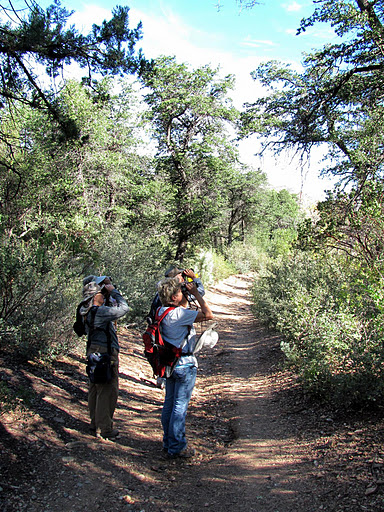
Birders on a mini expedition at last year’s Prescott conference
Posted in AZFO, Events | Leave a comment