Get Involved!

I think one of the great things about birding as a hobby is that anyone, everyone, can get involved and contribute to our knowledge of birds.  Citizen science also allows amateur enthusiasts to affect conservation and provides a learning opportunity.

What I want to mention is the North American Migration Count.  It’s a lot like a CBC, an annual nationwide snapshot of bird abundance.  There are some differences.  For one thing, rather than a count circle, the NAMC runs at the county level.  The other important difference is that the NAMC occurs on only one day, the second Saturday of May.  This year, it’s happening on May 14.  If you can be out in the field that day, consider joining in the count, and contact your local coordinator!  The link above lists all the county coordinators in Arizona.  Another thing to consider is birding a new area.  If you live in a county with a lot of birders, how about volunteering in an underbirded county like Greenlee, Graham, or La Paz?

Another way for Arizonans to get involved is to join in one of AZFO‘s Field Expeditions.  These are like super field trips, outings with a purpose, with some goal towards better understanding the status and distribution of Arizona’s birds.  This May (21-22) there will be a backpacking trip to the Galiuro Mountains in southeast Arizona.  Who even knows what that could turn up!

Posted in AZFO, Events, North American Migration Count | Leave a comment

Big Year update

Things have been very busy lately, and unfortunately I’m not referring to birding!  The past two weekends I’ve gone out of town, first to Phoenix then to Santa Cruz, CA.  Not to mention the intervening week which I spent working full-time!  At least in both cases I did get some birding in, and both weekends were fun, but I’ve gotten a bit off track with my Mohave County big year!  Since I’ve been neglecting this blog, I thought I’d post a status update on my big year.

The total so far stands at 165.  I was pretty pleased when my FOS Cliff Swallow (flying over LHC February 24) landed me 150, halfway to my goal of 300!  The latest addition was actually a completely new (though overdue) county bird, Yellow-headed Blackbird.  Yesterday while I was outside for work (not birding), a flock of 14 flew over!

I’m feeling pretty good about the year so far.  This project has gotten me out birding in some places pretty far off the beaten track, and I’ve found two second county records – the Rufous-backed Robin in Kingman and the Dusky-capped Flycatcher in Wikieup.  It’s also gotten me looking for some birds that are very local in the county, and David and I were successful in finding a pair of LeConte’s Thrashers.

Cold Rufous-backed Robin

Winter is the time for waterfowl, and this winter has been great.  Three species of geese (no Greater White-fronted or Cackling), Tundra Swan, and 24 duck species.  Mohave County is great for diving ducks, and I’ve already added all three scoters, Long-tailed Duck, Barrow’s Goldeneye, and of course, Greater Scaup.  The only duck I’m likely to add at this point is Eurasian Wigeon…though I’m still looking for the really rare ones!

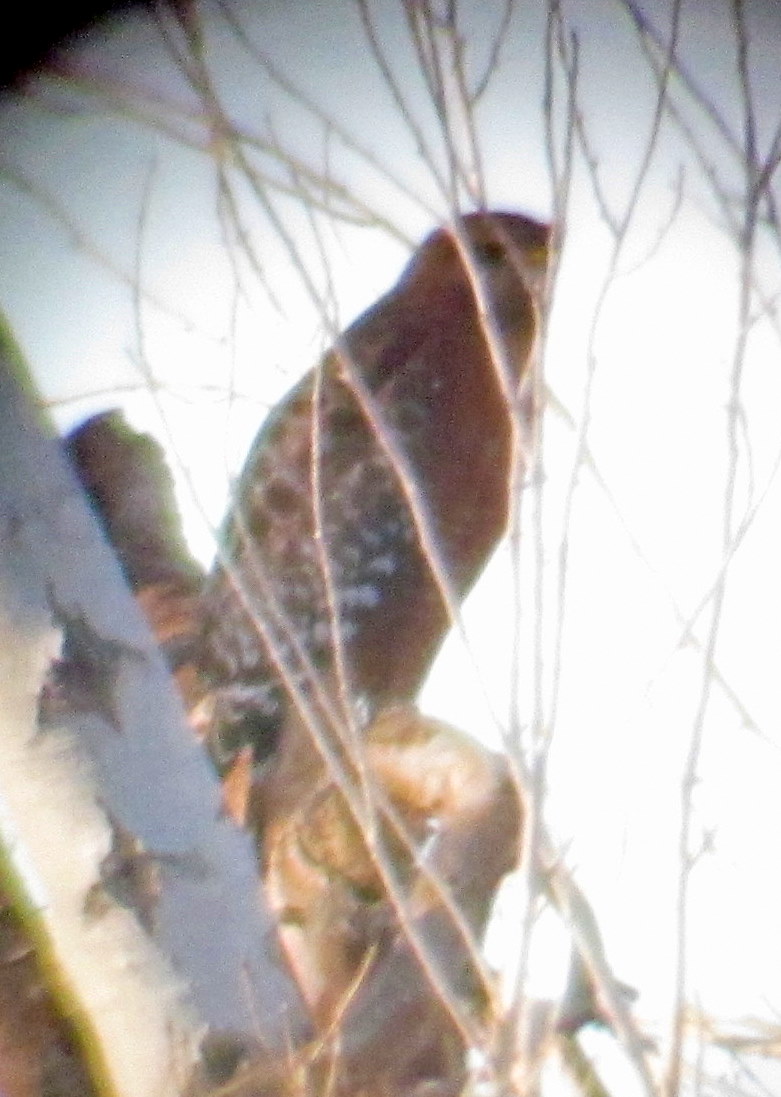
I’ve been doing fairly well with raptors, though there are some gaps I hope to fill.  The highlight so far was the Red-shouldered Hawk at Pintail Slough, which John West found and pointed out.  I didn’t make it up to the Arizona Strip this winter, so I’m missing Rough-legged and Ferruginous Hawk (as well as Northern Shrike).  I have some very local breeding raptors to look for…Northern Goshawk on Mt. Trumbull, Common Black-Hawk on the Big Sandy River, and Harris’s Hawk around Wikieup.  Swainson’s Hawks haven’t arrived yet, but they are a widespread breeder in the central part of the county.

The most skittish of Red-shouldered Hawks

Four species of gulls includes the Bullhead City Mew Gull, and 13 species of sparrows isn’t bad for a start–I’m still checking every White-crowned Sparrow flock for a White-throated!

As the migrants come in over the next two months, I’m hoping to add plenty of “easy” birds: warblers, flycatchers, hummingbirds, shorebirds.  Another few trips to the mountains will hopefully bring new woodpeckers, finches, and corvids.  Then of course there’s no telling what vagrants will find their way here!  In the short term, I’ll be looking for more night birds – I’ve seen Lesser Nighthawk and found three species of owl, but there are more owls and Common Poorwill out singing!

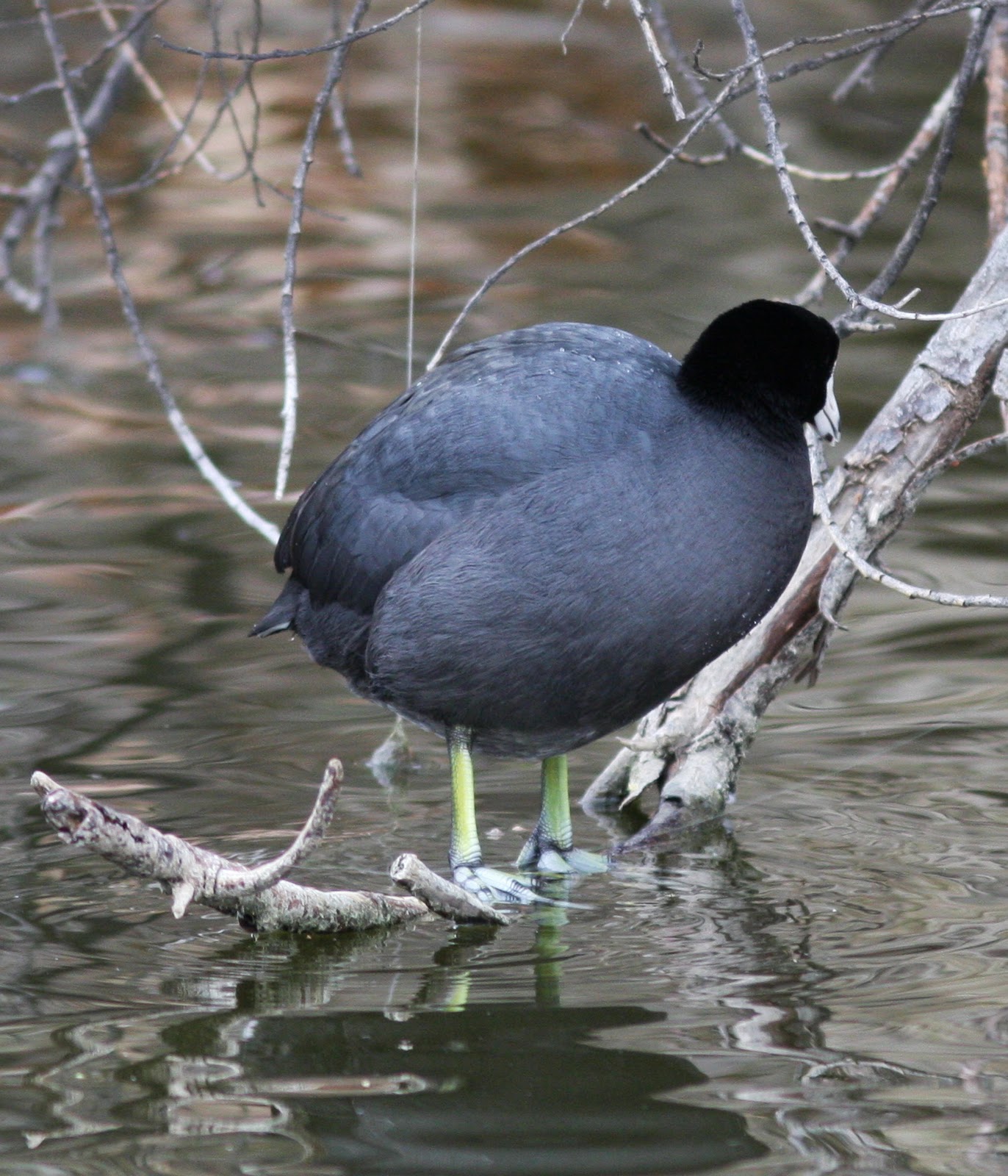
My bet for #166?  Common Moorhen.  They are plenty common out here, and I am amazed that I haven’t managed to find one for the year.  I know one will turn up eventually, and I’m looking forward to seeing what’s next!

Always a coot, never a moorhen!
Posted in Big Year, Havasu NWR, LCRV, Mohave County, Vagrants | 1 Comment

Long-tailed Duck

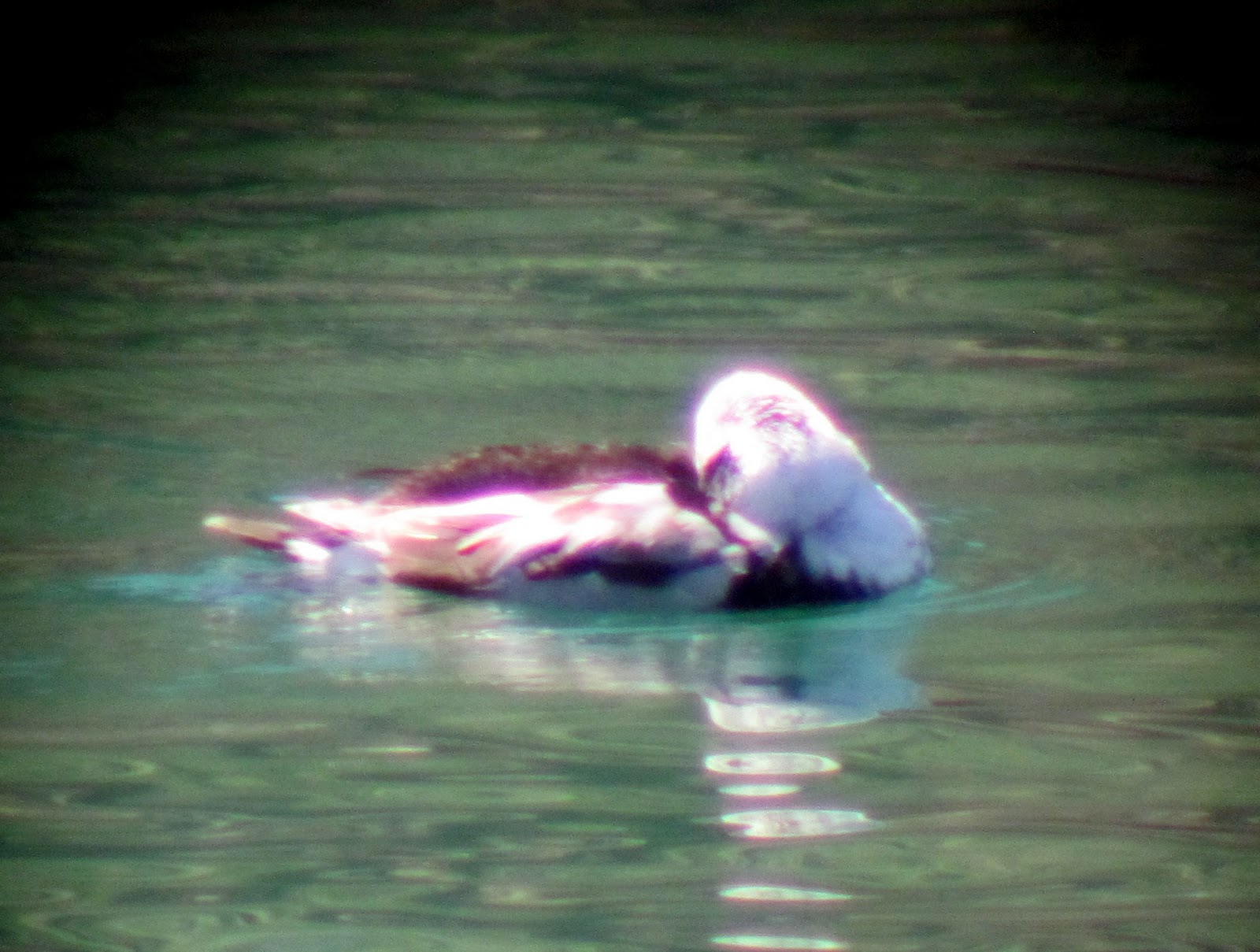
On February 28 of this year, refuge volunteer Jan Richmond spotted a drake Long-tailed Duck near the Bill Williams River NWR headquarters.  This is a rare bird in Arizona, a “Sketch Details” species found mainly on the Colorado River.  I was very pleased that this guy hung around long enough for others to see it – partly because it’s such a beautiful bird, and partly because it was a new species for me for Mohave County!

I went out to the Refuge HQ this morning for a bit of birding.  The Long-tailed Duck was much closer today than it was when I saw it before, swimming contentedly in La Paz County, in the CAP inlet.  I got a few low-quality images, which I doctored up a little bit by darkening them.

I can’t say I fully understand the complex molt strategy of this species, but this guy appears to be pretty squarely in his “winter” plumage.  The short tail feathers, however, suggest a young bird – maybe a third-year?
Posted in Bill Williams, La Paz County, LCRV, Vagrants | Leave a comment

First spring migrants

Migration is complex in the LCRV.  Spring migration begins in January, when swallows and some waterfowl begin to move north.  The latest of spring migrants are here in June, which is also when fall shorebird migration begins.  November marks the arrival of many wintering duck species.  At practically any time of year, something is migrating in the LCRV.
 
The appearance of spring migrants in late winter is probably related to the mild climate and abundant food resources of the region.  Also, some of these movements may not pertain to migration as much as shifts in the wintering range.  According to Rosenberg et al. (Birds of the Lower Colorado River Valley, 1991),

 “…there is evidence that some species may make midseason adjustments in their winter quarters in response to sudden changes in local weather or food supply.  These moves may be in the form of continued migratory behavior, as in some small insectivores, or as massive invasions into more suitable habitat, as in berry-eating waxwings and thrushes.  …Thus, the notion of a static winter range for many species may be inappropriate, as winter in the lower Colorado River Valley is very much a time of flux.”

Below, I’ve recorded some of the early movements that we have seen in January and February.  (This only includes a few observations from other birders.)  Our field observations are compared with Rosenberg et al., the standard reference for the region.
Cinnamon Teal
The first report of this species in the region this year was by John West, who counted nine in the Castle Rock area on January 2.  David and I had two at Pintail Slough January 24, and Kathleen Blair had two on the Bill Williams January 25.  Our first flock of the season was at Pintail Slough February 20, when we had ten.  By February 26, the number at Pintail Slough increased to about 80.  It is not unusual for a few individuals to arrive in early to mid-January, with migration picking up in early February.  It seems that Cinnamon Teal migration is happening a few weeks later than “typical”.
 
Blue-winged Teal
Our first and only Blue-winged Teal this season was a drake in Lake Havasu City January 27.  This species occurs irregularly in the LCRV, though spring migration typically begins in mid-February.
Red-breasted Merganser
David’s FOS Red-breasted Merganser was off Take-Off Point on February 4.  Sightings of one on Lake Mohave February 20 and two on Lake Havasu February 22 were more typical of early migrants, which usually appear around mid-February.
 
Turkey Vulture
This winter had Turkey Vultures wintering further north and migrating earlier than listed in Rosenberg et al.  While this species was formerly absent in winter north of Parker, we had about 11 wintering in the Parker Strip, as well as one individual in the Mohave Valley seen January 5.  We observed migration beginning in mid-January, when scattered individuals arrived around Lake Havasu City.  The first flock we saw north of Parker Dam was of 19 birds near Catfish Paradise on February 22.  Other flocks have been observed since that date.  This is slightly earlier than noted in the book, when spring migration began in early March.
 
Ash-throated Flycatcher
This species is an uncommon winter resident.  Our first migrant of the season, a singing bird at Pintail Slough February 20, was right on time.
 
Tree Swallow
We observed the largest concentrations of wintering birds on Lake Havasu, especially the north end.  Estimates of larger flocks during the winter ranged from 200-400.  We observed the first influx on February 18, with 770 at the north end.  Flock sizes then began to increase throughout the region, and our high count in February was 1200 at the north end of Lake Havasu February 26.  Distribution of this species is complex and highly variable year-to-year, though peak spring migration occurs in March.
 
Violet-green Swallow
Migration of this species began as a trickle this year.  The first report of the season was January 19, when Kathleen Blair recorded five at Kohen Ranch.  My FOS was one in Lake Havasu City February 1; I saw another on the Parker Strip February 3.  We didn’t see more until February 20, with two at Pintail Slough and one on Lake Mohave.  Since February 21, numbers have greatly increased, with a few counts of 10 to 30 birds and widespread scattered individuals.  This seems to be a slightly late arrival of this species; migration typically begins in early February.
 
Northern Rough-winged Swallow
Numbers of this species seem to be low this year.  Small numbers wintered south of Parker Dam.  Beginning in late January (as is typical), we began to see small numbers as far north as Willow Beach.  Our high count is 15, from Pintail Slough February 26.
 
Cliff Swallow

Arrival of Cliff Swallows this year seems typical.  The first reported in the region was on February 22, when Kathleen Blair had one at the Bill Williams NWR HQ.  David and I had our FOS two days later in Lake Havasu City.

Posted in LCRV, Migration | Leave a comment

Big Sandy River

Yesterday, David and I decided to spend the day birding around Wikieup.  We both kind of wondered whether it would be worth going in the winter, since our main targets there are breeding species: Northern Cardinal and Bridled Titmouse, both of which were found on the Breeding Bird Atlas.  We decided to go anyway, check out the area, and see what we might find.

A big front had passed the night before and dumped snow on all the mountain ranges (including the Mohaves, uphill from LHC).  Driving through Kingman, we were dazzled by all the snow that had fallen there and in the Hualapais.  Soon we came to signs saying “ROAD CLOSED” and we thought, they can’t mean I-40?  But they did, and as luck would have it, the interstate was closed just past our exit, highway 93.

Snowy desert near Kingman

Heading south, we soon passed into the shadow of the Hualapais and the snow disappeared.  We started exploring around Lower Trout Creek Road, but didn’t manage to find much birding.  Eventually we made it to the only eBird hotspot in the region, Burro Creek Campground, on a tributary of the Big Sandy.  The scenery certainly didn’t disappoint.

After a slow morning, it was a relief to bird a spot with even moderate bird activity.  About 30 migrating Violet-green Swallows flew over in a stream, along with a few Trees; some typical riparian birds were active along the creek.  It was certainly a surprise when a Golden-crowned Sparrow turned up with a handful of White-crowned Sparrows – a new state bird for David and a county bird for me!  I’ve been checking sparrow flocks all winter looking for this species, so it was great to finally find one.  This has been a very slow winter for Golden-crowned Sparrows in Arizona; the only report I know of was a few weeks ago in southeast AZ.

Photo by David Vander Pluym

With plenty of time left in the day, we did a bit of exploring around the Poachie Mountains south of Burro Creek.  Driving Seventeen Mile Road, we followed eBird’s County Birding protocol to see what birds were typical there.  The habitat was an interesting transition zone:  juniper and other higher-elevation plants were mixed with saguaro, creosote and such desert plants.  Most of the birds were desert species such as Cactus Wren, Gilded Flicker, Phainopepla, and Black-throated Sparrow.  There were also some species more typical of juniper woodland, like Bushtit and Oregon Junco.

David enjoying the scenery at a randomly selected birding location
Saguaro

When we reached the Big Sandy River once again, we were a little disappointed with the lack of riparian habitat.  However, we spied a few ranches just across the river with nice-looking open fields with scattered brush, and decided to check them out.  Walking down the road, we didn’t have many species, but there were a lot of birds.  A single Mountain White-crowned Sparrow was among many Gambel’s White-crowns.  Brewer’s Sparrow was an overdue addition to my Mohave County year list.

Our last stop of the day was along the Big Sandy River in the town of Wikieup.  Driving along Cholla Canyon Ranch Rd, we were frustrated by a whole lot of “No Trespassing” signs, but finally found a way to access the river that seemed legitimate.  Once we got into the habitat, we were floored.  Extensive riparian habitat stretches for miles, with tall cottonwoods and patchy understory.  This place seems golden.  It wasn’t long before we hit a flock, with more birds than we’d had most of the day.  A harsh scolding call alerted us to a Plumbeous Vireo, rare in winter.  Wandering through the sandy riverbed, we reached another area with budding cottonwoods and good bird activity.  While David was checking out a tree full of Gila Woodpeckers and Audubon’s Warblers, I stopped to scan the tops of another set of cottonwoods.  While I scanned, I heard a faint call that I couldn’t place.  I figured it must be something really distant at first, but eventually I heard it clearly:  a mournful, descending “wheeeeur” call that I know well.  It was a Dusky-capped Flycatcher, calling softly but regularly.  I called David over and we both listened to the calling bird.  Unfortunately, it was in one of the few areas with a really thick understory, and a solid wall of tamarisk stood between us and the bird.  That didn’t stop us from trying to see it, and we crawled through tangles of tamarisk in a vain attempt to see the flycatcher.  In the end, all we had to show for it were tamarisk needles everywhere.

Prior to this winter, there were only about five records of Dusky-capped Flycatcher in Arizona in winter.  This winter, though, one turned up in Maricopa County, then the bird at Parker Oasis (La Paz County) was discovered, and now there is this one in Mohave County.  In summer, this species is typically found in southeastern Arizona but does wander northwest of its typical range.  Rosenberg et al. gives one record from Topock, but I know of no other sightings from Mohave County.

Needless to say, we were pretty satisfied with our day on the Big Sandy, even though we never got to see the Dusky-capped.  More than anything, I am really excited to see what else may turn up in this spectacular area in the future!

Posted in Big Year, eBird, Mohave County, Trip reports, Vagrants | Leave a comment

Spring Around the Corner

I have to admit, late February around here is starting to taste like a flat soda.  Several of the local rarities continue, but there don’t seem to be many new birds moving into the area.  While there has been some notable gull movement, they just seem to be leaving – without new birds coming in.  Birding is getting rather predictable.  Caught in the late-winter doldrums, the best we can do is keep monitoring the wintering birds, see how long the rarities will stick, and watch out for new migrants.  While doing just that this weekend, it was refreshing to see some signs of spring.

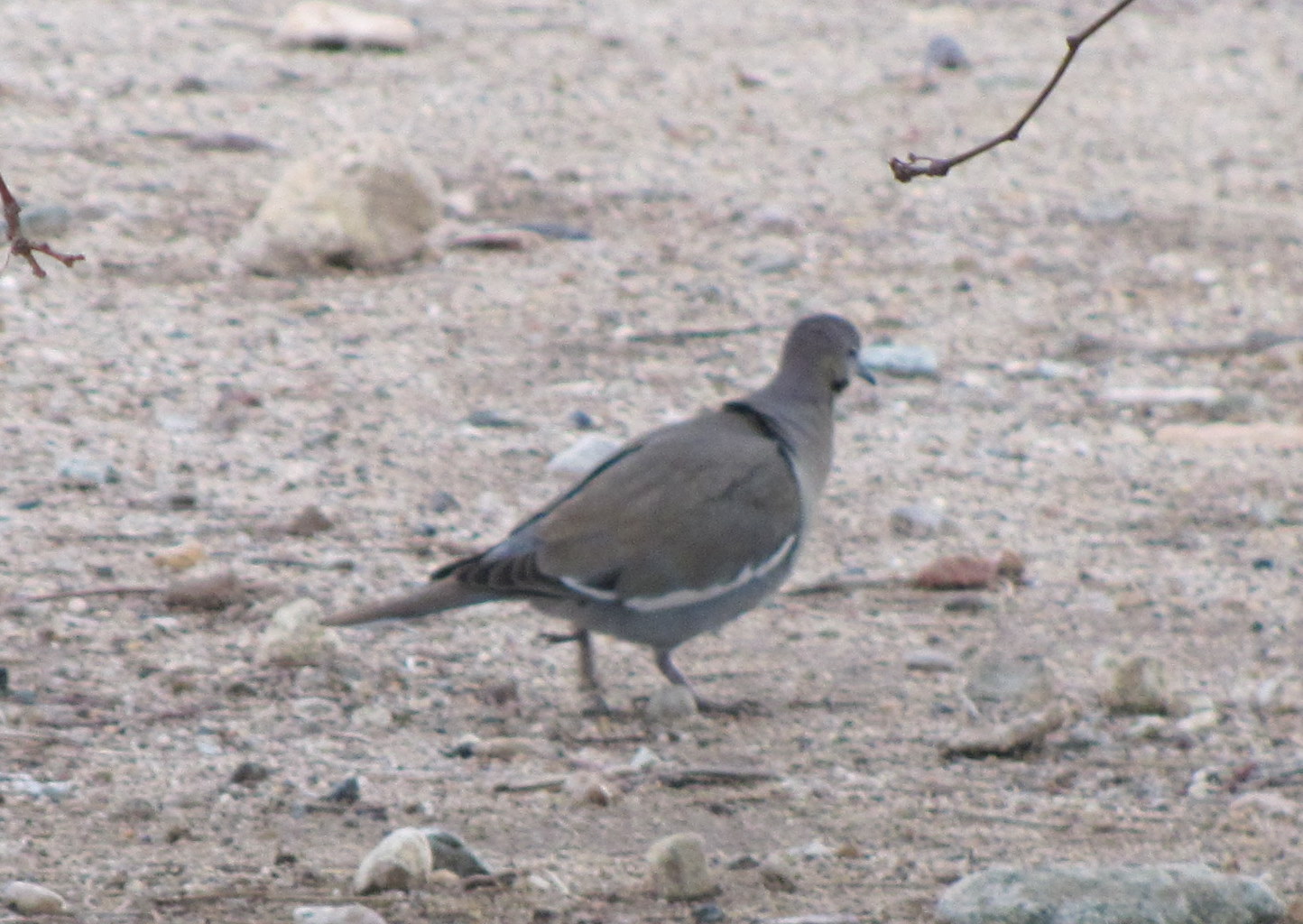
Starting at Rotary Park on Sunday, David and I found that gull numbers were down, and none of the eleven California Gulls I saw on Friday remained on the beach.  Starting the day off on a bright note, though, we saw our FOS White-winged Dove.  This was a surprise, since this species does not typically arrive until mid-March!

It didn’t want its picture taken.
As we headed north to Havasu NWR, we noted large numbers of Tree Swallows foraging over the road.  Within the past week, we’ve seen Tree Swallow numbers skyrocket.  At Pintail Slough, we enjoyed the increase in bird activity that comes after a rain, though we didn’t have any rare species.  A couple of Violet-green Swallows were good to see, indicating the beginning of their spring migration.  With the exception of a few sightings of single individuals in early Feb, this weekend was the first real movement of this species we’ve seen this year.  This is actually a late arrival, as Violet-greens should show up around the first week of February.  Another spring migrant, a singing Ash-throated Flycatcher, was right on time.  This was a county year bird for me, as was a flyover flock of White-faced Ibis.  After a bit of walking, we discovered a few swarms of Neuropterans.  Freshly molted adults were emerging en masse.  Surprisingly few birds were taking advantage of this easy food source, though I suspect all the swallows foraging over the road were doing just that.
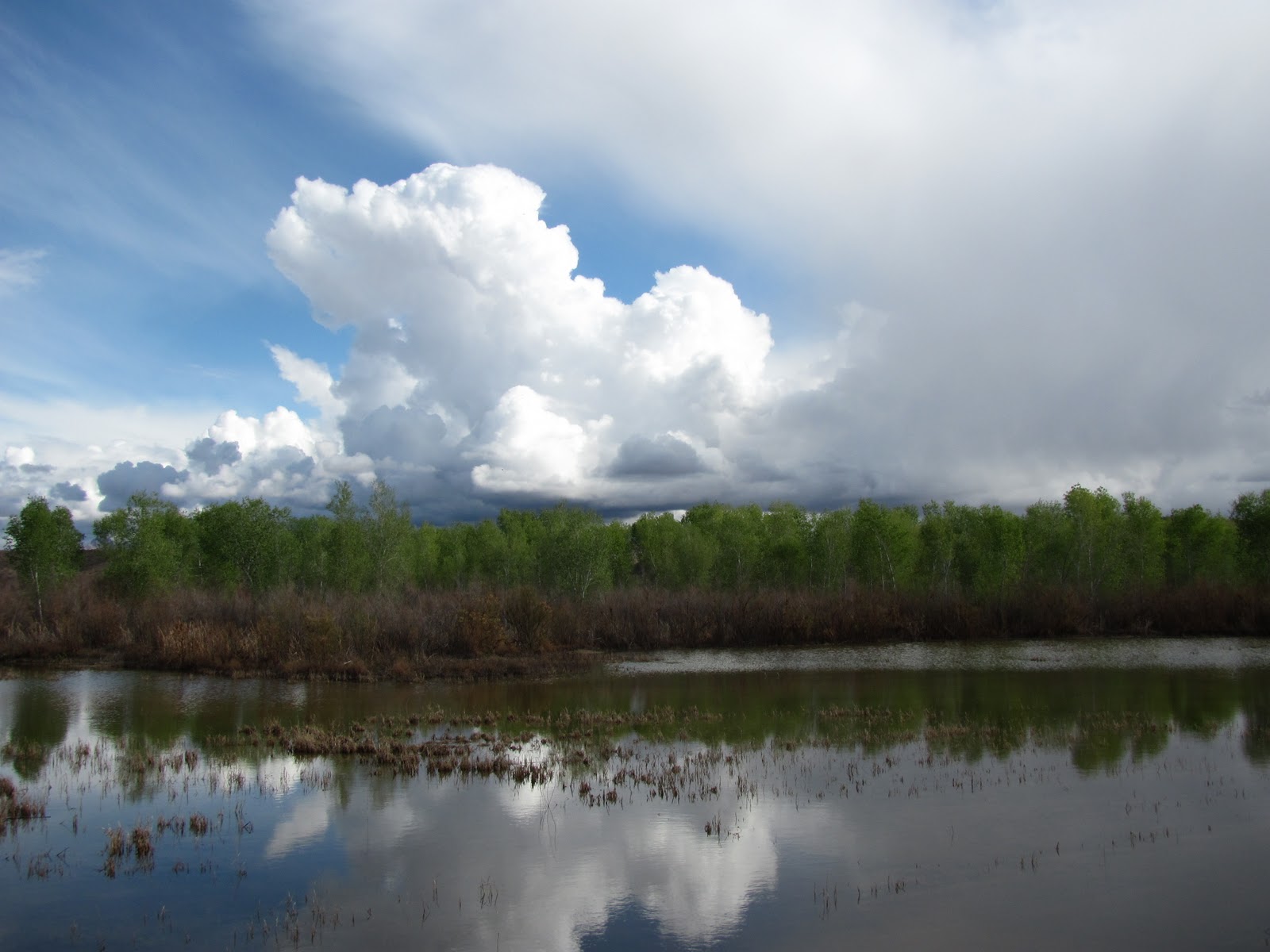
Pintail Slough – leafy cottonwoods and storm clouds
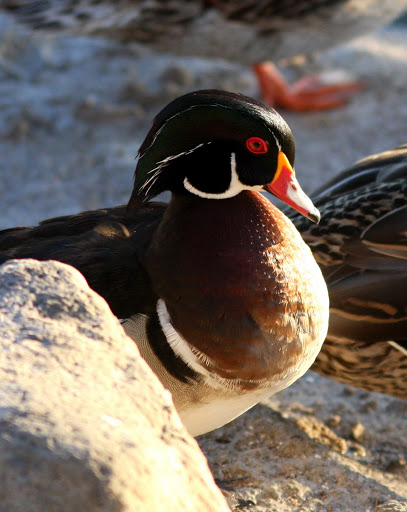
We ended our Sunday birding around Bullhead City, where we saw the continuing Mew Gull twice.  While we were driving through Bullhead City in the mid-afternoon, we briefly saw it fly over the car.  Around 6 p.m., it showed up at Katherine Landing and loafed with the Ring-billed Gulls.  Alas, the Thayer’s Gull seen earlier in the week did not show up.  It was interesting to note that numbers of California Gulls were way, way down, with only a handful of individuals seen.  Herring Gulls were absent altogether.  We did see five Horned Grebes on Lake Mohave, and three Wood Ducks in the area.  A male Red-breasted Merganser was unusual for this time of year, and another county year bird.
One of two males in the bread line at Katherine Landing
Monday was spent around the Bill Williams Delta.  We checked out Mosquito Flats, a beautiful stretch of riparian forest with complex structure and very little tamarisk.  The cottonwoods are fully leafed out, humming with the constant buzz of bees, and ready for migrant warblers.  The warblers, of course, are not migrating yet, and the birding was a little slow.  Fortunately there were other distractions.
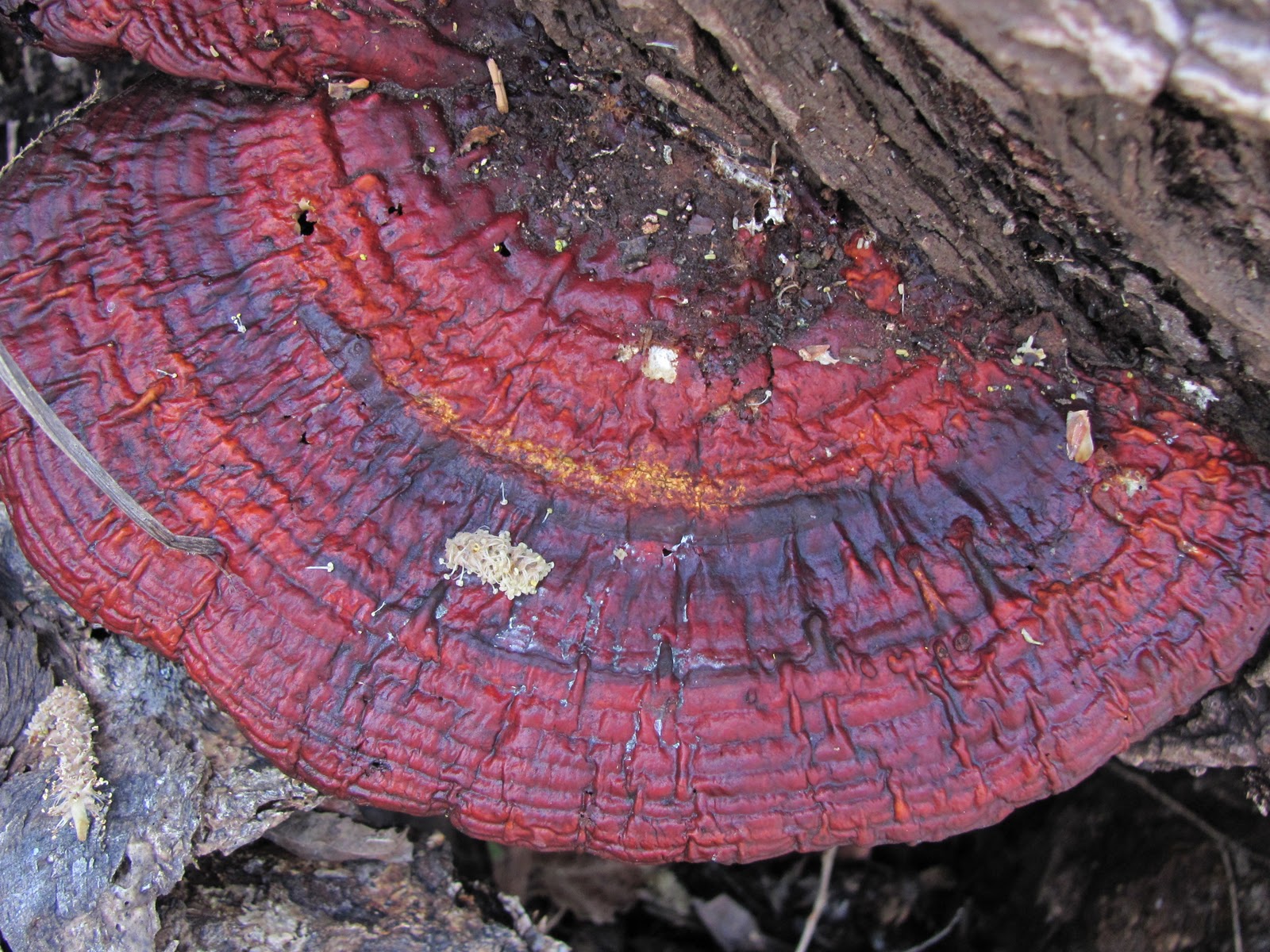
 Cool fungus
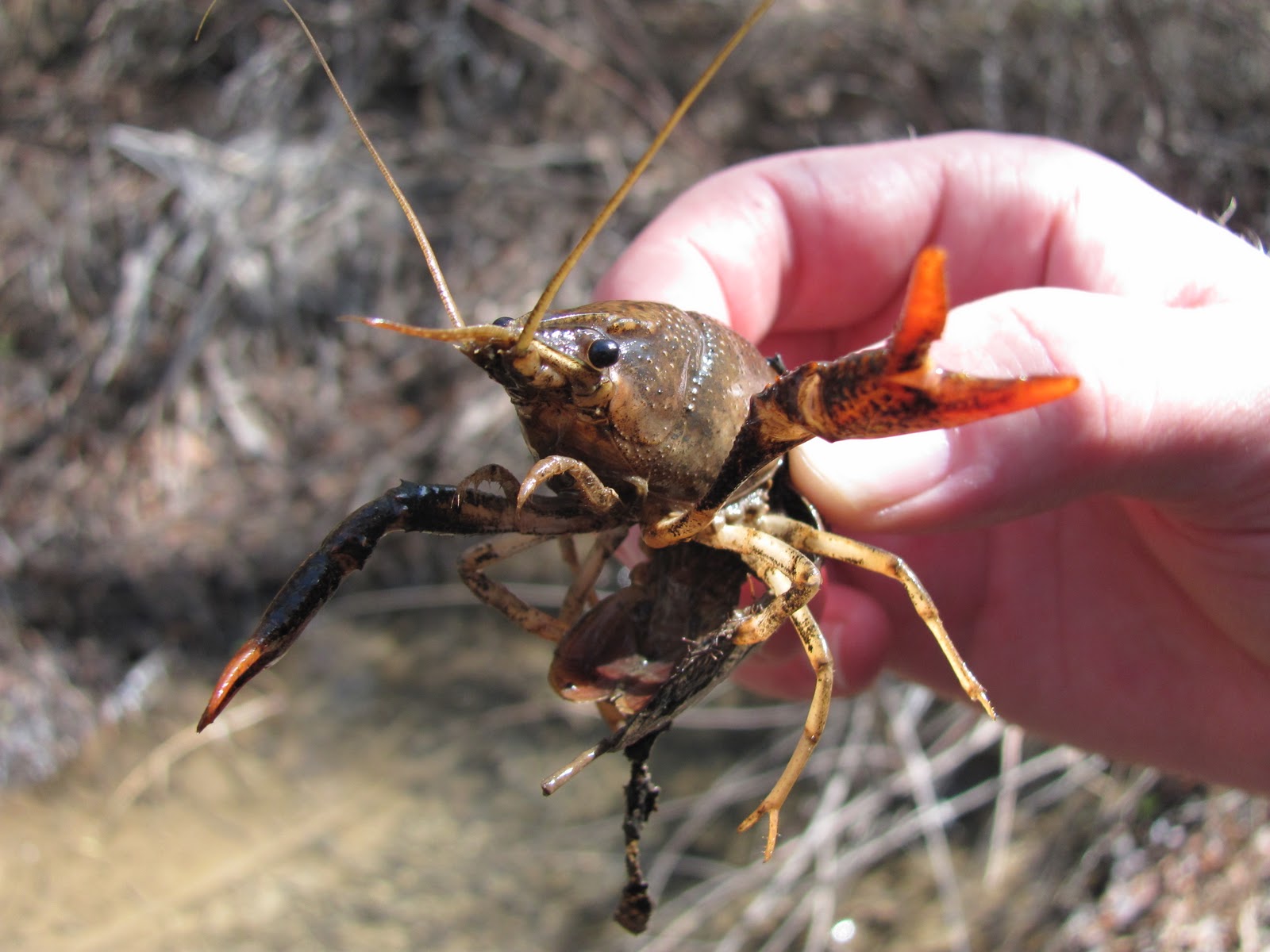
Crayfish – an invasive species.  I managed to trap this one under my boot so we could get a better look at it.
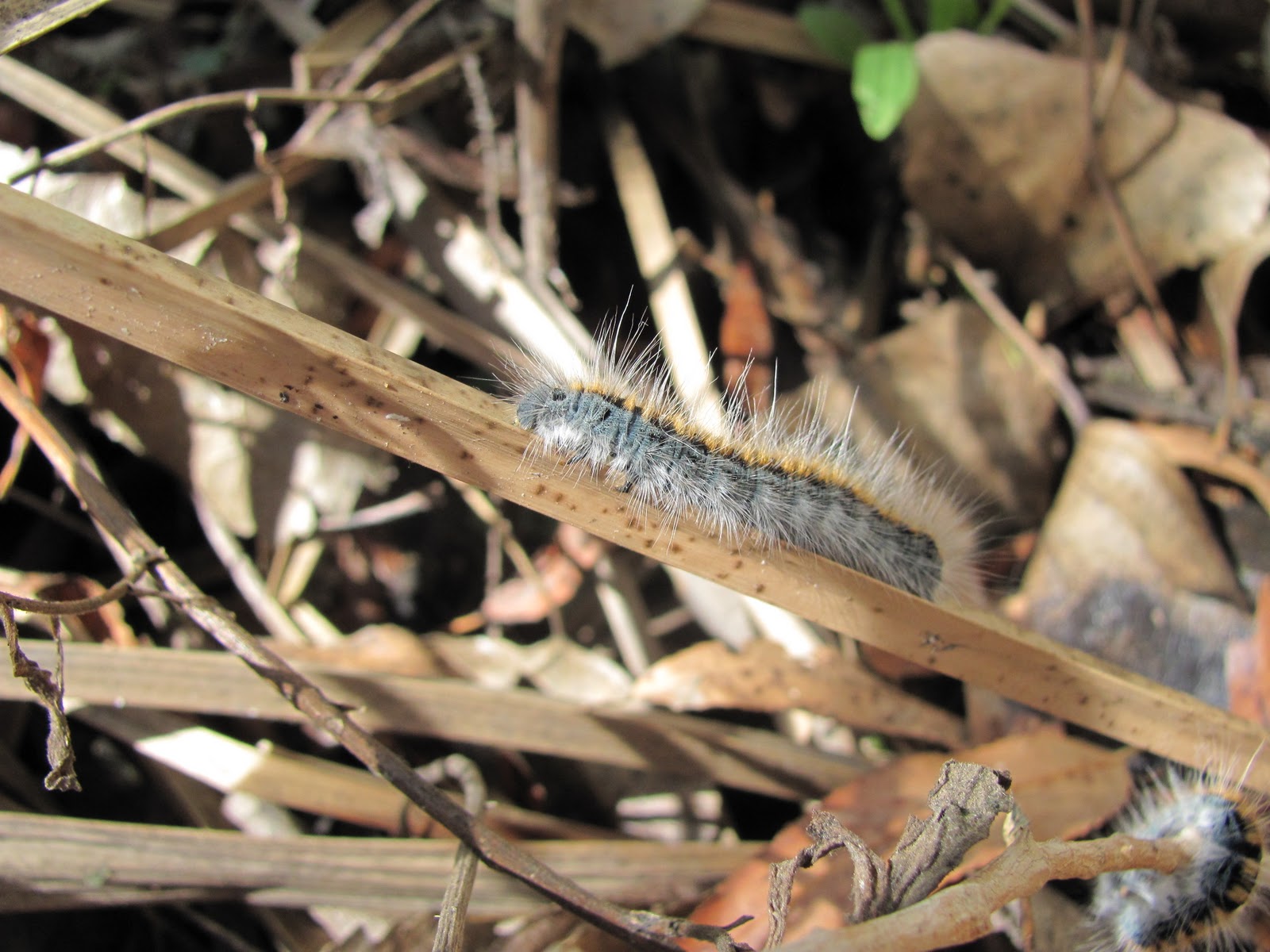
Tent caterpillars were everywhere!
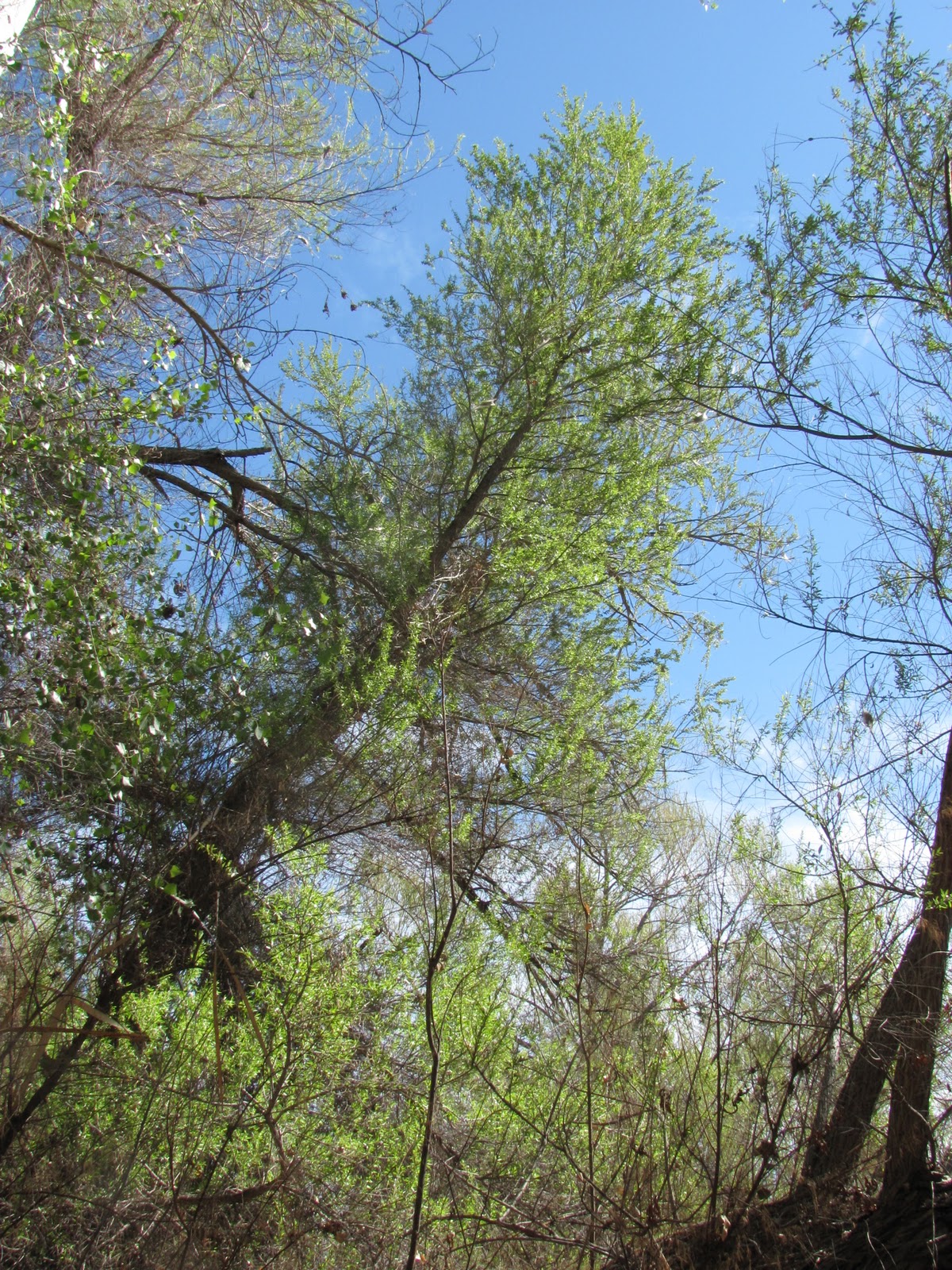
Most of the trees are fully leafed out.
We headed for the Bill Williams Delta, one of the best birding spots in the region.  There are almost always rare species to be found at this spot, and it is always exciting to bird, as it seems to offer more turnover than other places.  Some of the continuing rarities were Greater Scaup, Barrow’s Goldeneye, and Black Scoter.  Almost all of the scaup, a flock of 230, were fairly close to our viewpoint, allowing us to get an accurate count and search for Lesser Scaup (none found).  The two female Black Scoters were with the scaup, as usual, and we counted eight Barrow’s Goldeneyes, a new high count for us this winter.
Next, we headed for Parker Dam.  The birds there have been particularly predictable this winter, but we want to catch any changes as soon as they happen.  Lately, we have made it part of our routine to check Take-Off Point next to the dam.  Though it has been very quiet this winter, there had been sightings of the Yellow-billed Loon from there, and we have been checking for the bird (unsuccessfully) whenever we’re at the dam.  To our surprise, on this particular check, there it was!  Along with five Common Loons, the Yellow-billed was in the Bill Williams Arm – in Mohave County!  An excellent county bird (year bird #149) for David and I, though one can’t help but wonder – why does this bird bother to fly back and forth over Parker Dam?
A weekend of late February birding had the effect of getting us excited about April.  With so much habitat to cover, who knows what will turn up during migration!
Posted in Big Year, Bill Williams, Havasu NWR, La Paz County, LCRV, Migration, Mohave County, Vagrants | Leave a comment

Keeping notes and eBird

After a great weekend of birding, the field notebook I was using was filled to its last page.  This always gives me a great sense of accomplishment, wrapping up a notebook’s worth of birding experiences and ornithological data.  On top of that, I was proud for another reason – of the pile of notebooks whose whereabouts are known, all of those bird data have been entered into eBird.  It took some time to catch up, especially with the many checklists I still had to enter from Costa Rica.  All was complete, and it got me thinking about this pile of notebooks collecting dust in a closet.  Sure, those data are all online now, but there’s more than bird checklists in those notebooks.  Sketches, notes on birding locations, county birds, even historic records I copied out of old issues of North American Birds during long days at the museum – all of that is still in there.  So I decided to label my notebooks.  Nothing extensive, just my name, the date range, countries and states included, and any other notable goodies.

I have to admit that during the labeling process, I uncovered a half-full notebook spanning 2006 to 2009, with barely any of the checklists entered!  It took me two days to go through the pages, figuring out what was already in eBird, and entering the remaining checklists.

All of this work I put in begs the question, why bother putting all this stuff into eBird?  I don’t throw away the notebooks afterward, and I keep all my lists in Excel spreadsheets anyway.  For me, there are so many good reasons to use eBird that it’s hard to know where to start!

So let’s start with the purely selfish reasons: it’s a free listing software.  I’ve never paid for listing software, but from what I know, that stuff isn’t half as good as eBird.  The only list I really keep in eBird right now is my Mohave County year list.  It takes me 18 seconds to pull it up, and I can see when and where I first got each species.  Say I want to look at all my observations of Blue-gray Gnatcatcher in Mohave County in 2011, I click on the bird and it turns out I’ve only had them twice, once at Lehman Hill and the next day at Kohen Ranch.  I can click on the location for Lehman Hill and see that I’ve seen 45 species there this year.  I can do the same with my life list – say I want to see in how many states and countries I’ve seen Ovenbird.  I click on the species and eBird shows that I’ve entered observations of Ovenbird from Veracruz (Mexico), Maine, Ohio, and California.  If I’m only interested in numbers, there’s a page called “My eBird” where I can browse any list total that I’m interested in.  Glancing at the “states” section, I can see that I’ve entered the most species for California, with 388.  I have 107 species in Washington, 1 for Michigan.  This is curious…I’ve never been to Michigan.  I click on the “1” and see that I have House Sparrow on a checklist for the Detroit airport…well I guess you have to start somewhere.

But eBird is not a listing software.  It’s a citizen science project.  The Cornell Lab of Ornithology uses all these observations as a massive data set, similar to other citizen science projects such as the Great Backyard Bird Count, Christmas Bird Counts, Project FeederWatch, Breeding Bird Surveys, etc.  Only a lot bigger.  So if you’re using eBird as a listing software, and you’re entering sightings at the county level instead of specific locations, or putting a month or a year or a lifetime’s worth of sightings into one checklist, you’re sidestepping the utility of those sightings to science.  eBird reviewers find those checklists and remove them from the data set – your lists aren’t affected, but those kinds of checklists just aren’t useful to the project.

So why is that important?  How does eBird use all those data, anyway?  I’m always interested in that very question, since I like to know how my work is paying off for the birds!  One of my favorite articles on the eBird home page is on the Animated Occurrence Maps that have been created for several bird species.  Check out a few of these maps.  Biologists use eBird data to create a model predicting the presence or absence of a species in a given area on a given date.  It’s not completely accurate, but it does paint quite a picture of where a species occurs and how it moves throughout the year.  Biologists also use eBird to track species of concern, such as Rusty Blackbird.

Finally, my favorite thing about the eBird data set is that it is open for anyone to use and explore.  A few examples.  Let’s say I really want to see a Black Rail – not a hypothetical situation.  I can look at the global range map for that species to see where it occurs.  Since it occurs in Arizona, that’s probably my best bet to find one.  So I can pull up another map showing me where Black Rails have been reported in Arizona, with specific locations, dates, numbers, and observers.  I see that almost all the records fall on the Bill Williams, including a bright yellow recent observation.  I click that marker to see that this species has been recorded several times in the past month between Highway 95 and the gate on Planet Ranch Rd.

The maps are great, but I really love using eBird’s bar charts.  Let’s use another example.  Say I’m going to Costa Rica, and I’ll be spending a lot of time in the province of Heredia.  I can pull up a bar chart showing me what species have been recorded, and their annual occurrence.  Or, imagine we’re in Washington County, New York in April, and it’s a totally new place.  I really want to see, say, a Snow Bunting.  I can check out that bar chart to find that I should pick a new target bird, because Snow Buntings depart in mid-March.  There only limit to the utility of the eBird data set is what is entered by birders like you and me!

eBird is for anyone interested in birds, no matter their skill level.  No one is expected to find and identify every bird, and there is an extensive review process to find and review sightings that are out of range and/or season.  That leads me to a word of advice.  If you’re entering eBird and suddenly the program asks you to click a box to confirm a sighting, go ahead and confirm it if you’re sure of what you saw!  Then click the “Yes” at the top of the page where it asks if you want to enter more details, and write a description of the bird you saw, or an explanation of how you arrived at an unusually high count.  I do this even for a continuing rarity, or for a count that I don’t think is unusually high.  When you click that “confirm” box, an eBird reviewer then decides whether there is enough information to enter that sighting into the permanent scientific record.  They may even email you to ask for more details.  Writing a description as soon as the record is flagged is a good habit to get into, and it saves everyone time.

Get out there and eBird!

Posted in eBird, Techniques | Leave a comment

Links

There are quite a few webpages and videos out there right now that are at least a little relevant to LCRV birding, so I’d like to share some here.

For anyone looking for information on birding the LCRV, there is quite a bit out there!  Mark Stevenson wrote an excellent article, mainly on where to bird the valley.  For the average birder making a one- or two-day trip, this is the best source of info – read it here.  Of course, most birders coming through the area are seeking some known rarity.  For information on current rarities, David and I maintain a Google map.  I also maintain a Google map for birding locations in western Arizona, currently just Mohave County, that has a bunch of sites for the birder who wants to try something new or different – check it out here.

Arizona Highways ran a very cool segment on the Bill Williams River.  It has a bit of the history of the area, what to do there, shows some beautiful scenery, and features local birder John West!

Of more general birding interest, I wanted to share this article.  It’s by Oregonian Dave Irons, on the lost art of written bird descriptions.  I highly recommend reading it and practicing the tips given by Dave…I know I am always trying to improve my written descriptions!  One paragraph in particular was quite poignant…

No one but you can truly know what you saw or determine what you get to count on your own life list. The purpose of collecting written documentations is so that they can be archived for future generations. In my view, an unaccepted report is just as valid as one that has been accepted. In each case, the only thing we know for sure is that a particular time and place the reporting observer believed that they saw a particular species of bird and was confident enough in their observation that they reported it to others. Whether the local field notes editor or your regional records committee decides that your description is sufficient to endorse and further publish is a completely different matter.

Last but not least, bird blogger Laura Kammermeier has been busy making the funniest birding videos I’ve ever seen!  Check out “I Saw a Rare Bird“, “There It Is. Over There!“, and “Let’s Get Our Larophilia On, Shall We?

Posted in Bill Williams, eBird, LCRV, Techniques | Leave a comment

Mew Gull – Bullhead City

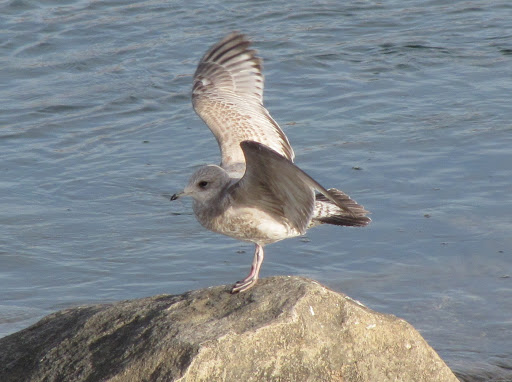
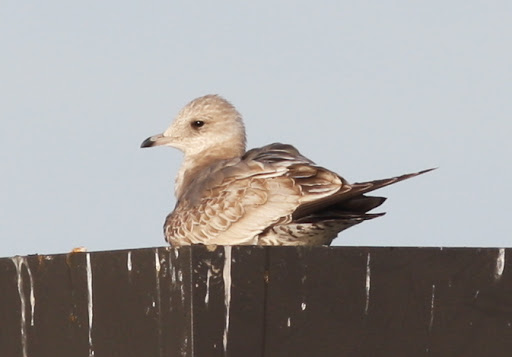
Way back on January 29, David and I embarked on an epic day of birding…well, not all that epic, until we crossed the Bullhead/Laughlin bridge (just south of Davis Dam), and noted a gull flock loafing below the bridge.  We pulled into a parking lot just across from the gulls, and David started scanning with the scope.  Looking through binoculars, I noticed that the far-left bird looked a little “off”, just a little, well, little, and smudgy.  I asked David if I could please have the scope for a moment to check out a gull.  Looking through the scope, I saw brown primaries and my eye rested on the petite bill – a Mew Gull!

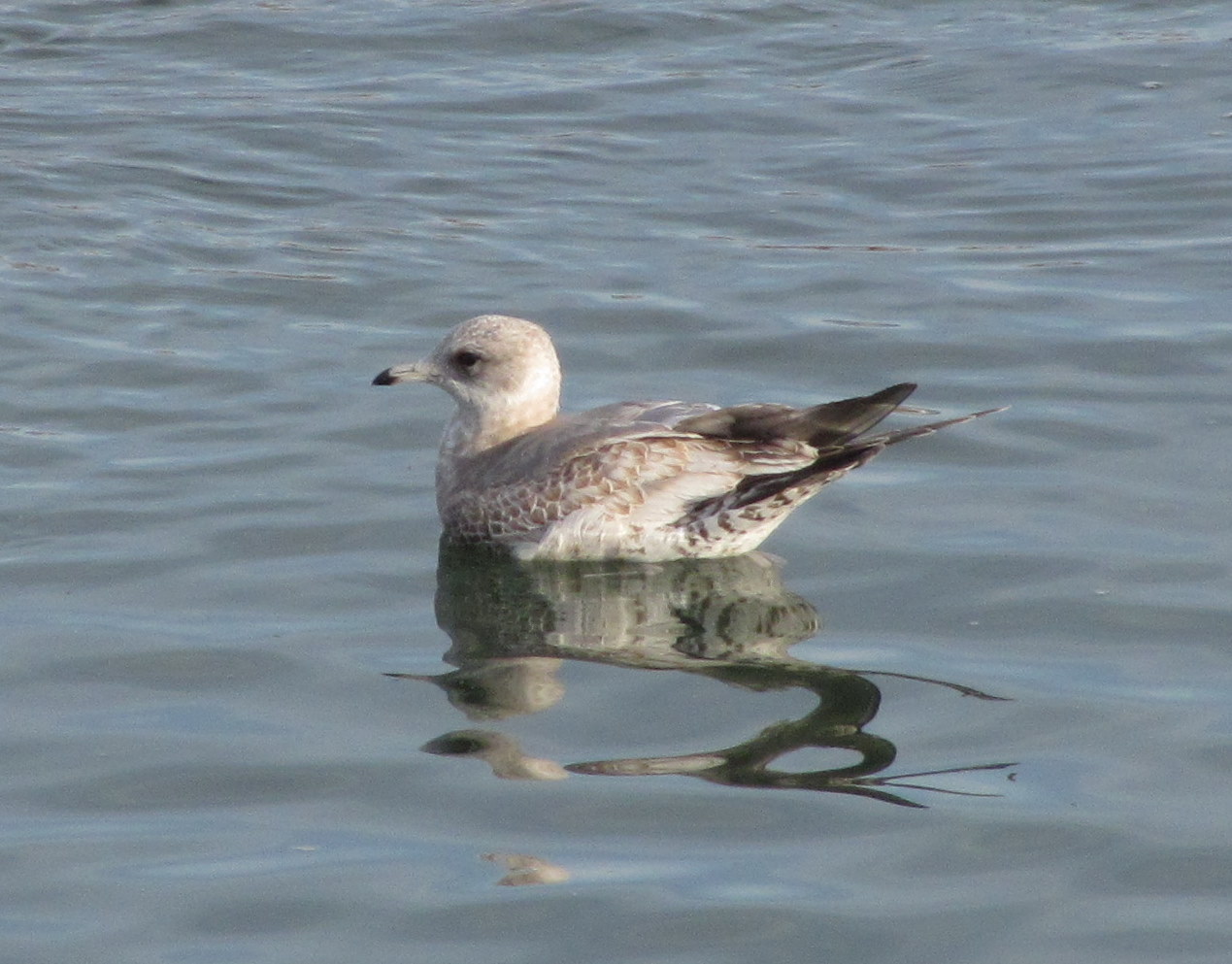
The American population of this species (probably a good species itself) is fairly restricted to the Pacific Coast in winter, with only occasional strays inland.  If accepted by the ABC, this will be only the 13th Mew Gull recorded in Arizona.  Their rarity is compounded by the fact that they kinda look like young Ring-billed Gulls.  The photo below shows most of the relevant ID points – all-brown tail, tiny bill, smudgy plumage, silvery under-primaries, brown outer primaries, and middle primaries with pale inner webs and dark outer webs and tips (among other points).

As far as finding and identifying rare gulls, well, they are a real pain in the ass.  In Lake Havasu City, we have swarms of Ring-billed Gulls, usually with no other species, at least this winter.  This has meant gull-watching has been really boring, so I’ve been staring at the first-cycle Ring-bills trying to turn them into Mew Gulls.  It is this kind of behavior that makes an actual Mew Gull really pop out – in particular, I keep mentioning the smudgy plumage, whereas most young Ring-bills have crisp, even pretty, speckling.

As of yesterday, the gull was still haunting the area – it was seen and photographed yesterday evening at Katherine Landing, where the bird seems to roost or at least stop before going to roost.

Posted in Identification, LCRV, Mohave County, Vagrants | 1 Comment

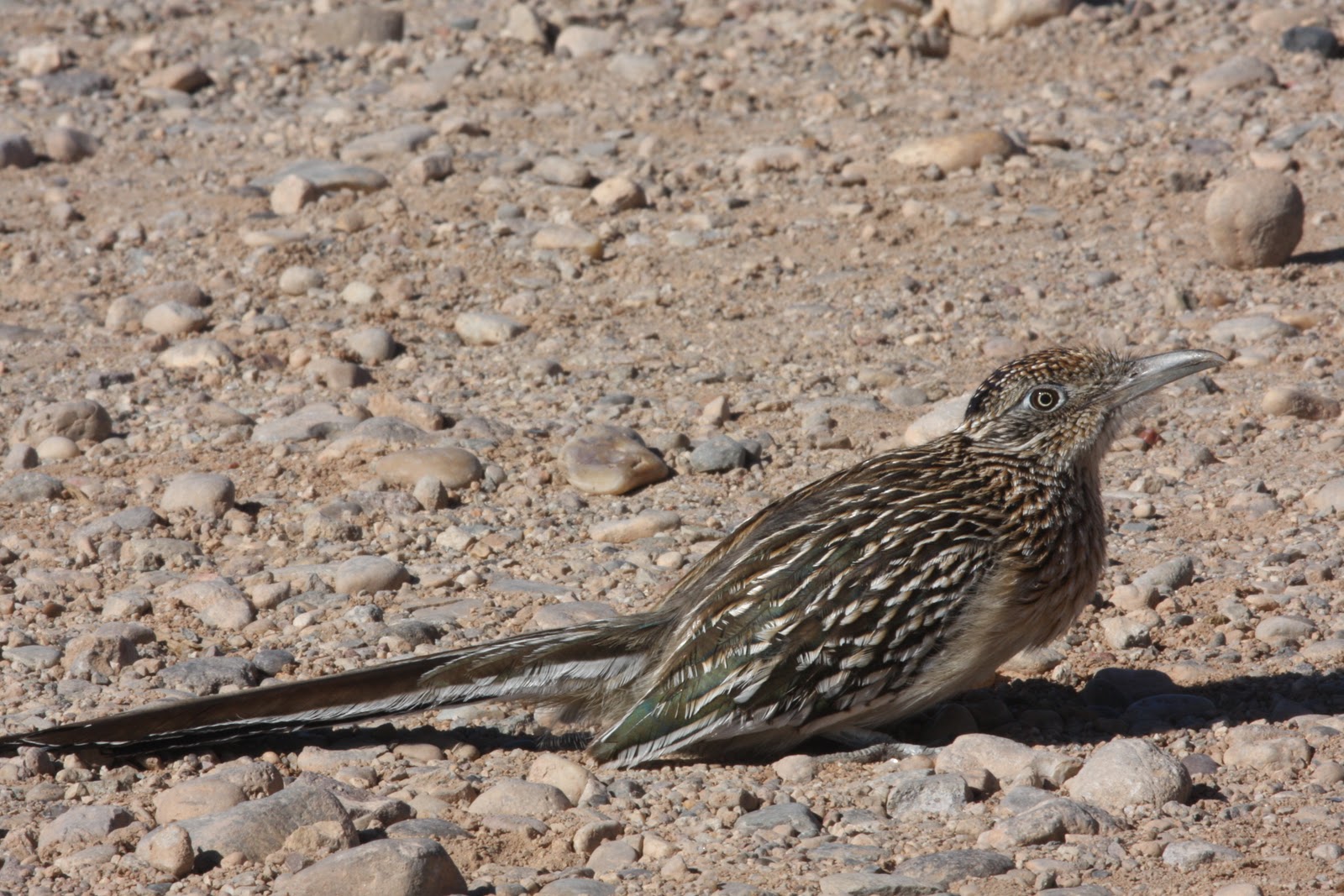
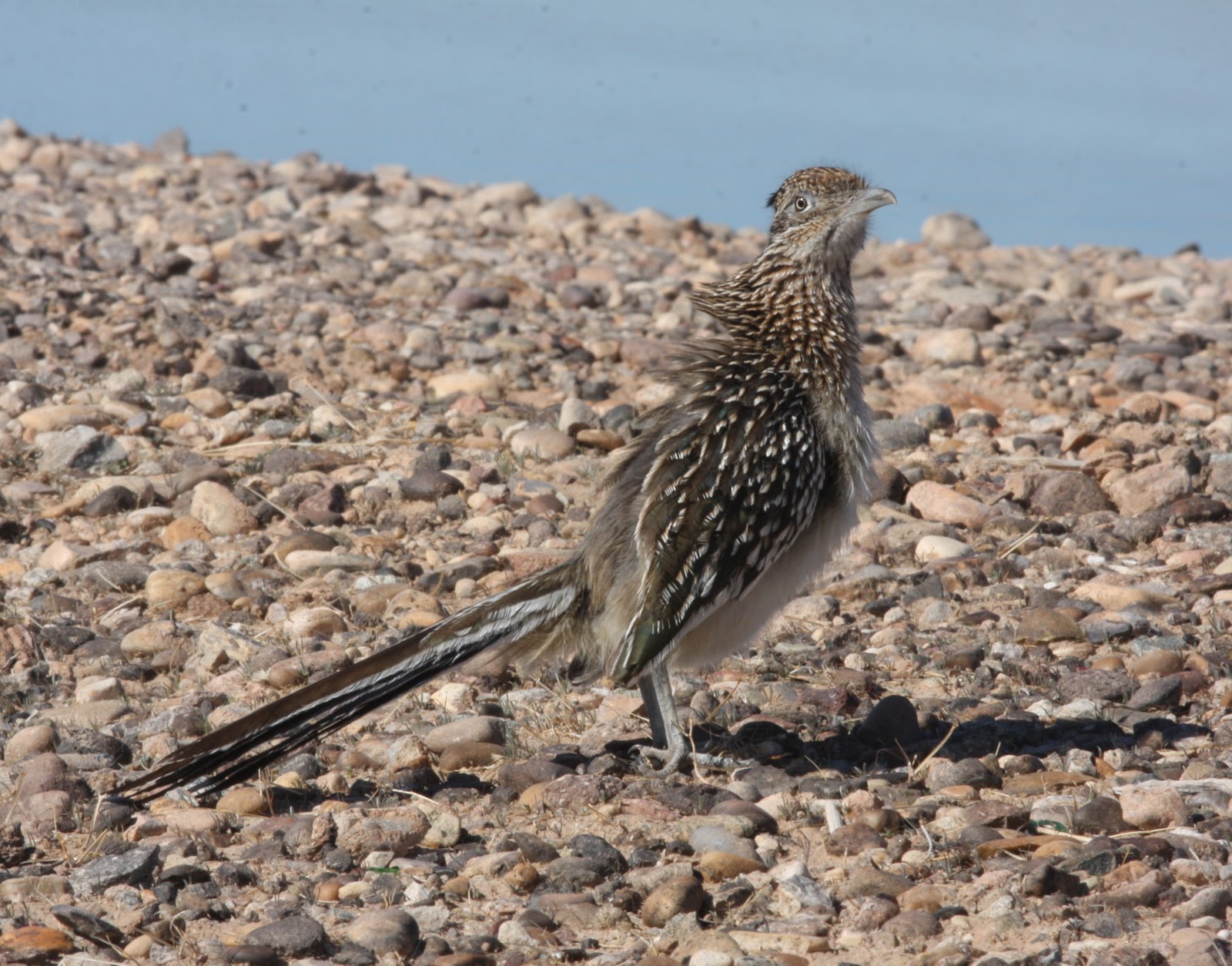
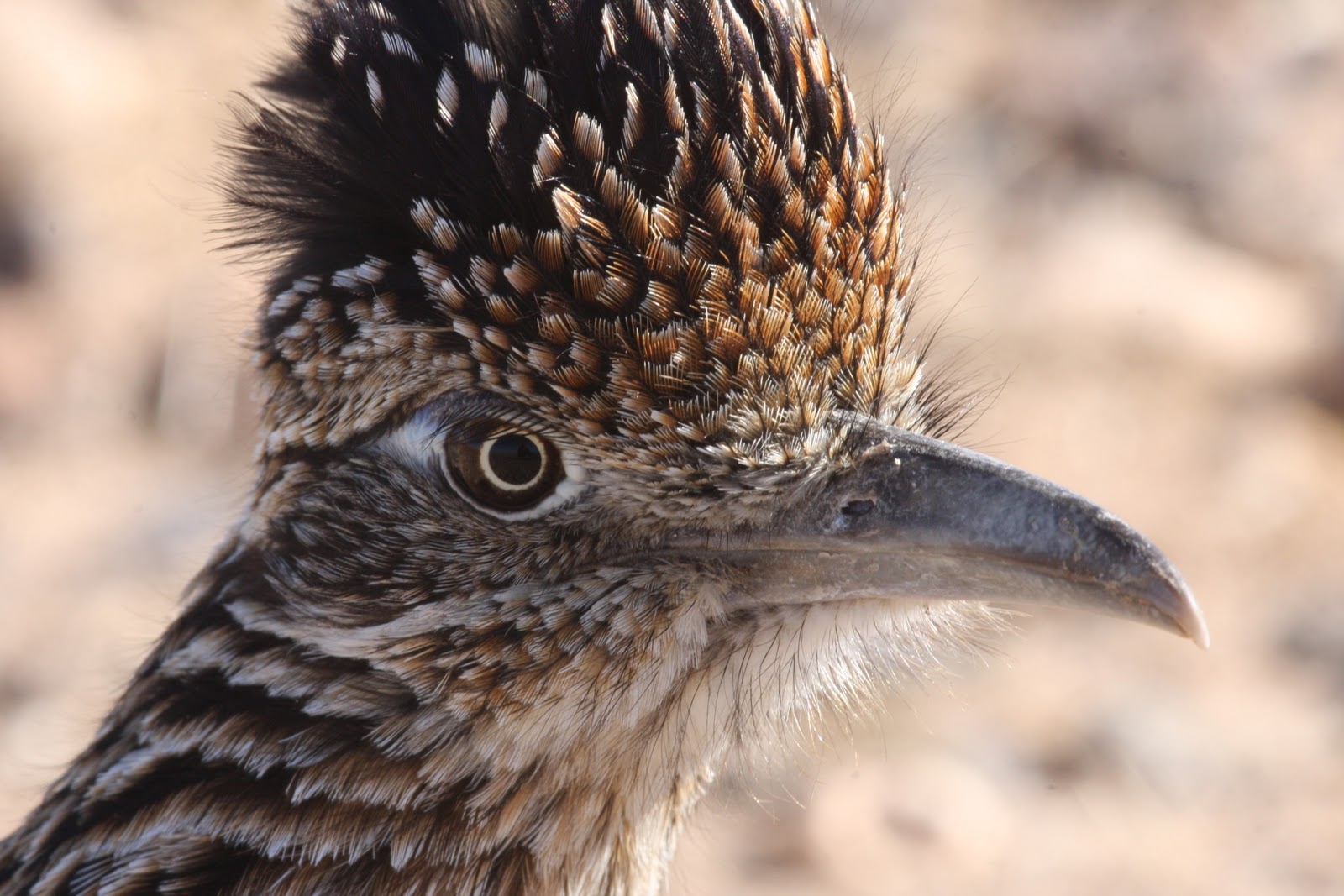
Greater Roadrunner

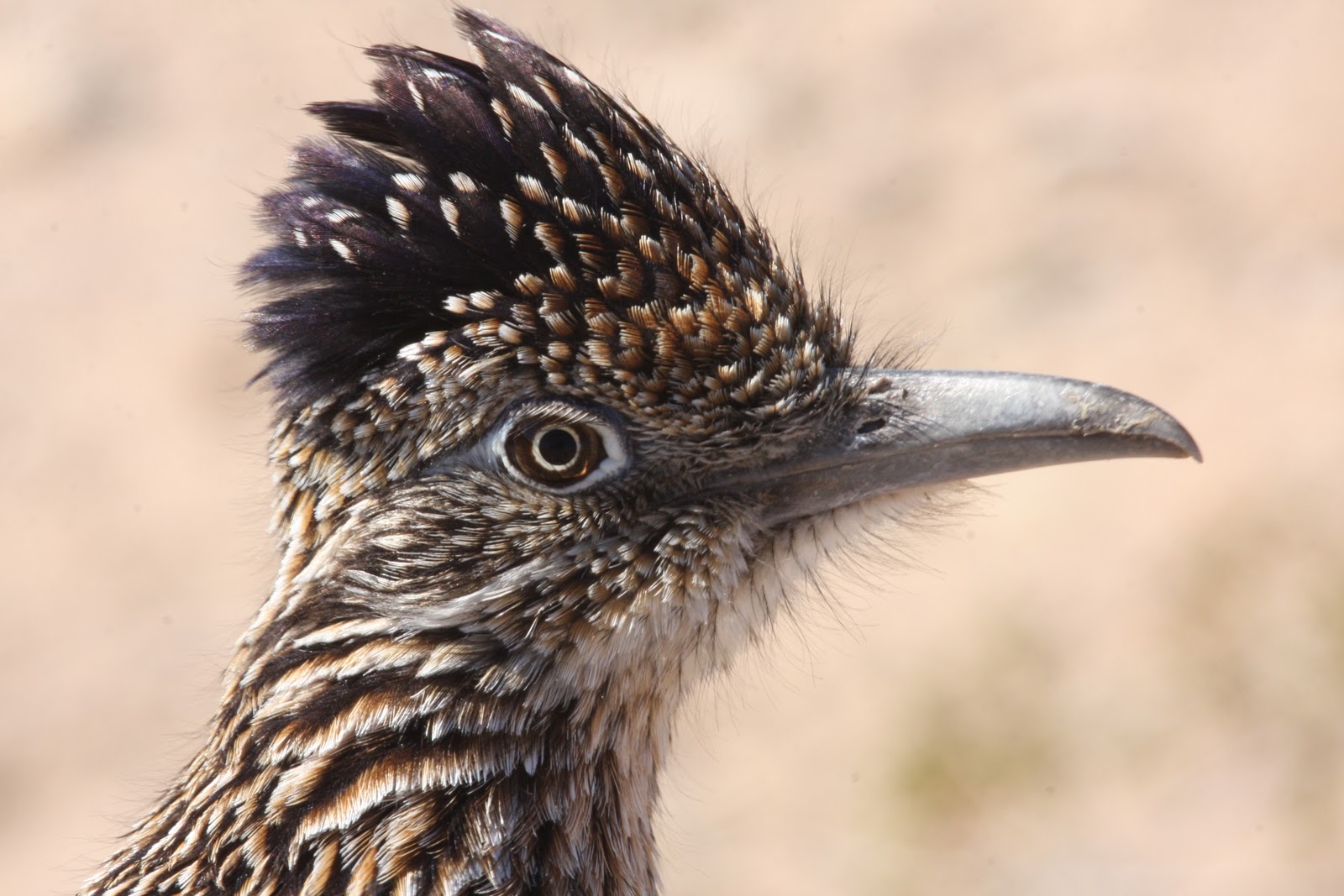
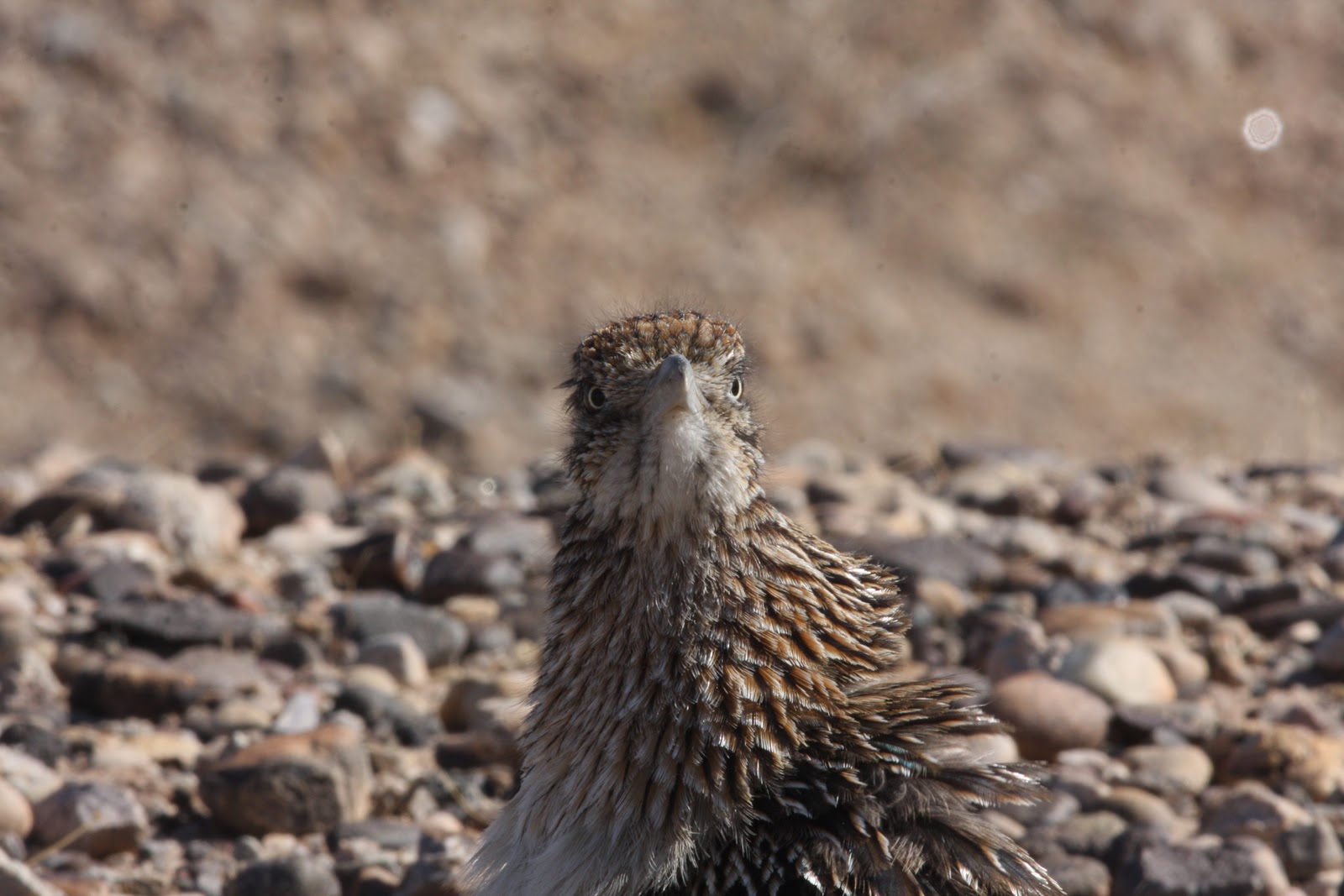
Yesterday, I had an opportunity to photograph a favorite desert bird – a friendly Greater Roadrunner.  I’ve encountered this individual before, a spunky bird with little fear of humans.

Most Americans are aware of the existence of birds called roadrunners, and lots of folks come to Arizona excited to see these birds.  Of course, the comic version most of us grew up with isn’t exactly accurate.  Unfortunately, real roadrunners don’t say “meep meep,” although this bird did repeatedly give an endearing “churrr” call.  Recently, when I was looking up how fast roadrunners can run (20 mph), I found an answer in the category of “flightless birds”.  Actually, roadrunners can fly – not very well, usually just gliding into cover – but they do it fairly often.
There are some pretty cool myths about these birds.  My favorite is that in some parts of Mexico, they are thought to bring new babies home, like the stork of the Old World.  They provide good luck to travelers, build cages around snakes, and of course, drop anvils on top of sneaky coyotes.

If you ask me, the facts about roadrunners trump the myths…except maybe the anvil thing.  Really, they are just large cuckoos adapted to life in the deserts of the southern U.S. and northern Mexico.  Their big bill is a lethal weapon, used to subdue lizards, nab birds, and even wrangle rattlesnakes.  Sometimes, they will even team up with other roadrunners to surround and kill a rattlesnake.  This bird would just lunge forward every once in a while to pluck an insect from the gravel.

Their streaky plumage is excellent camouflage in the desert brush, useful for both hiding from predators and sneaking up on prey.  When alarmed, they hunker down on the ground and wait for the danger to pass.

Being desert birds, they are well adapted to deal with heat.  The desert can get very cold, though, and roadrunners have a special adaptation for warming up:  their skin is very dark, and they will position themselves with their back to the sun, fluffing up their feathers and soaking up the heat.

The roadrunner is one of the greatest characters of the desert, with its expressive crest and tail, both constantly raised and lowered.  This was a great opportunity to study one of these birds up close, seeing all the intricate details of its plumage and enjoying its spunky personality.

Posted in Species Profiles | 2 Comments